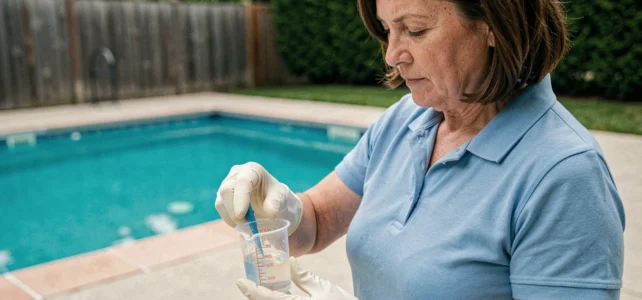
A 50 m³ pool turning green on a scorching Sunday, with ten guests expected the next day: this is the classic scenario where people overdose on bleach in a panic. The problem is almost never the amount poured, but the order of operations before adding anything. Mastering the dosage of bleach per m³ for pools requires understanding what happens upstream of the bottle.
Stability of bleach and storage: the point that no one checks before dosing
We often assume that the bleach purchased at the beginning of the season retains the same concentration in August. This is false. Sodium hypochlorite degrades due to heat, light, and contact with certain metals.
A container stored in a poorly ventilated technical room, exposed to temperatures above 30 °C for several weeks, loses a significant portion of its active chlorine. The result: we pour the theoretical dose, but the actual concentration of the product is lower than that indicated on the label. The pool remains under-disinfected, and we blame the dosage when it is the storage that has skewed everything.
Another rarely mentioned safety point: a pH that is too low combined with bleach can cause the release of gaseous chlorine. Before pouring, we systematically check the pH and never store bleach near an acidic product (for example, a lower pH liquid).
To properly understand the dosage of bleach per m³ for pools, we must first ensure that the product used has retained its properties. A bottle opened for more than three months in the height of summer deserves a test with a photometer before any volume calculations.
TAC, pH, then chlorine: the order of checks that changes everything
Most competing guides start directly with pH. In practice, recent feedback shows that it is better to start with total alkalinity (TAC). An unstable TAC makes it impossible to stabilize pH in the long term, and a fluctuating pH neutralizes the action of chlorine as soon as it exceeds 7.8.
Control sequence before each addition of bleach
- Measure the TAC with an appropriate kit (ideally a photometer rather than strips, which lack precision on intermediate values). Adjust if necessary with sodium bicarbonate to raise alkalinity.
- Check the pH and correct it between 7.2 and 7.6. Beyond 7.8, chlorine loses the majority of its disinfecting power, regardless of the volume of bleach poured.
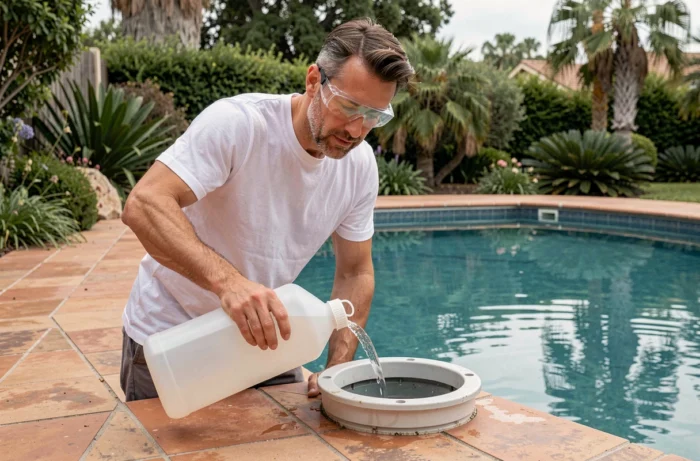
- Only after these two steps, pour the bleach by calculating the volume relative to the actual cubic measurement of the pool and the concentration of the product (9.6% for pool extract).
This sequence takes ten more minutes, but it avoids wasting product and multiplying blind corrections throughout the week.
Bleach dosage for regular maintenance and shock treatment
We are exclusively talking about pool bleach with 9.6% active chlorine. Household bleach (around 2.6%) is unsuitable: its low concentration requires pouring excessively large volumes, which disrupts pH and adds unnecessary additives to the pool.
Daily maintenance
For a 50 m³ pool, the field reference is one liter of 9.6% bleach per day. This volume maintains a sufficient free chlorine level to prevent the growth of algae and bacteria under normal usage conditions.
Always pour in the evening, with filtration running, in front of the return jets. Solar UV degrades free chlorine: pouring during the day means losing a significant portion of the product before it has acted. For smaller or larger pools, we adjust proportionally: about 20 ml per m³ per day.
Shock treatment after green water or heavy usage
The shock treatment aims for a chlorine level significantly higher than the maintenance level, around 8 to 10 mg/L. For 50 m³, this represents about 2.5 to 3 liters of 9.6% bleach, poured all at once in the evening, with continuous filtration for at least 24 hours.
No swimming until the free chlorine level has dropped below the comfort threshold (generally below 3 mg/L). We check with a photometer before allowing access to the pool.
Measurement with a photometer or strips: reliability of control after dosing
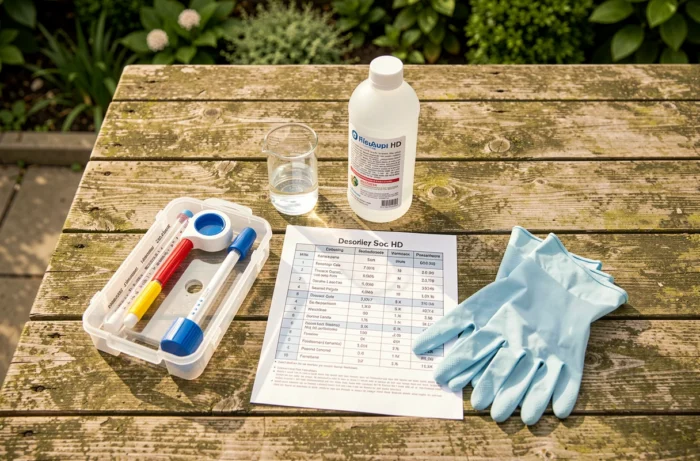
Correctly dosing is pointless if the subsequent measurement is approximate. Color strips provide an indication, but their margin of error is significant, especially on intermediate values of free chlorine and pH.
The photometer (or electronic colorimeter) offers precise digital readings. In practice, a photometer reduces interpretation errors and limits the risk of overdosing. The investment (a few dozen euros for a basic model) pays off in product savings and peace of mind.
When dosing bleach daily, a reading error of 0.5 mg/L on free chlorine can lead to unnecessarily doubling the dose the next day. Feedback varies on this point depending on the brands of strips, but the operational consensus clearly leans towards the photometer for regular monitoring.
High heat period: adjust bleach dosage without overdosing
Above 30 °C ambient air, water temperature rises, chlorine consumption accelerates, and the number of swimmers increases. The temptation is to significantly increase the bleach dose.
Recent recommendations lean more towards a fractionation of inputs: test free chlorine morning and evening, and adjust with small quantities rather than pouring a large single dose. This approach avoids irritating chlorine peaks and maintains more consistent disinfection over 24 hours.
During prolonged heat waves, we also check the stabilizer (cyanuric acid) if we are using it. An excess of stabilizer blocks the action of free chlorine, and bleach alone does not contain it, which is an advantage over stabilized chlorine tablets. But if the pool has received stabilizer earlier in the season, the accumulated level can become problematic.
The dosage of bleach per m³ remains a simple action as long as the complete chain is respected: proper storage of the product, checking TAC then pH, reliable measurement of free chlorine, and proportional adjustment to the actual volume of the pool. Skipping a step turns an economical treatment into a source of recurring problems.