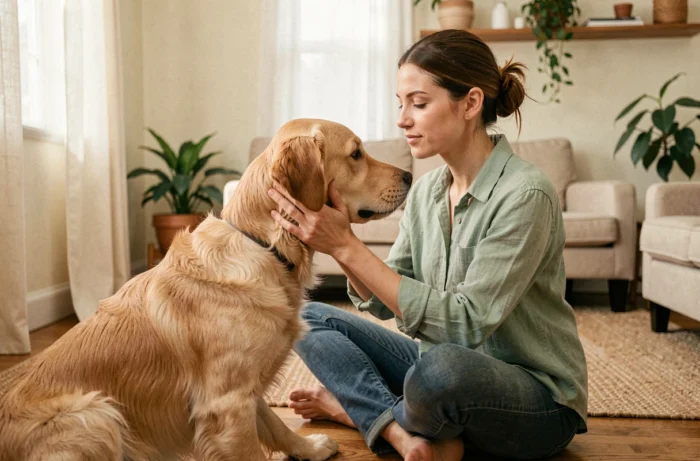
Your cat is staring at you from the top of the cupboard. Your dog is pushing his empty bowl with his nose even though he ate two hours ago. These behaviors tell something specific, but their interpretation often passes through a very human filter. Better understanding your pets means first accepting that their way of perceiving the world has nothing to do with yours.
Anthropomorphism and Pets: When Affection Blurs Interpretation
Have you ever noticed that your dog turns his head when you scold him? Many owners see this as guilt. In reality, this calming signal serves to de-escalate conflict. The dog feels no regret: he is trying to lower the tension.
This gap between what the animal expresses and what the owner interprets has a name: anthropomorphism. Projecting human emotions onto a cat or dog is not trivial. The intensity of the emotional bond does not guarantee the animal’s well-being and can even complicate it.
Dressing a dog that is not cold, forcing a cat to sleep against you when it prefers to isolate itself, comforting a fearful animal with caresses that increase its stress: these reflexes stem from good intentions. They respond to a need of the owner, not that of the animal. Many resources are available to analyze these signals on passion-animaux.net, which approaches the relationship between owners and animals from a practical angle.
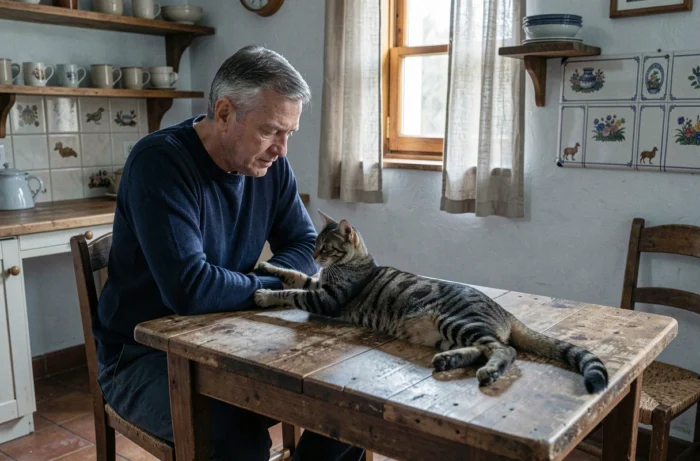
The nuance can be summed up in one sentence. Loving your animal means observing what it does. Loving it poorly means deciding what it feels.
Body Language of Cats and Dogs: Signals Not to Confuse
A purring cat is not always relaxed. Purring can also signal discomfort, pain, or an attempt at self-soothing. Similarly, a dog wagging its tail does not necessarily express joy: a high and stiff tail often indicates excitement or tension.
Here are some frequently misinterpreted signals:
- A yawn in a dog outside of tiredness indicates moderate stress, not boredom.
- A cat showing its belly is not asking to be petted there. It’s a sign of trust, but touching the belly often triggers a defensive reaction.
- Excessive licking of paws, in both dogs and cats, can indicate pain, an allergy, or an anxiety disorder, not just a grooming habit.
- A dog that freezes and looks away in front of a child is not being “well-behaved”: it is sending a signal of discomfort that sometimes precedes biting.
Observing the complete posture rather than a single gesture radically changes interpretation. Ears, tail, back posture, eye position: each element is interpreted in context, never in isolation.
Sleeping with Your Pet: Owner Comfort or Real Need
Sharing a bed with a dog or cat divides veterinarians and behaviorists. Some owners see it as the ultimate proof of the emotional bond. The reality requires more nuance.
A cat naturally chooses a high, warm, quiet place. If it sleeps on your bed, it’s because that spot meets its criteria, not because it loves you more than the radiator. Sharing sleep often responds to the owner’s comfort need more than that of the animal.
For dogs, nighttime proximity can reinforce an attachment disorder. A dog that cannot stand sleeping alone, that scratches the door or barks in your absence, sometimes develops separation distress that co-sleeping can worsen without causing it. The criterion is not “does he sleep well with me,” but “does he sleep well without me.”

If your pet sleeps next to you by choice and is capable of resting elsewhere without showing stress, nighttime cohabitation does not pose a particular problem. Otherwise, consulting a veterinary behaviorist can help identify any potential anxiety disorder.
Health and Prevention: Neutering, Identification, and Abandonment
Understanding your animal also means anticipating the consequences of uncontrolled breeding. Neutering and identification remain the most effective levers against abandonment. An unneutered cat can produce several litters a year, often unwanted. Identification via microchip facilitates return in case of escape and legally holds the owner accountable.
Realistic Evaluation of Lifestyle Before Adoption
A large part of abandonments results from a mismatch between the owner’s expectations and the reality of daily life with the animal. Selecting a breed or type of animal (age, energy, social needs) should go through a concrete checklist:
- How many hours a day will the animal be alone? A herding dog confined in an apartment without sufficient physical activity will develop behavioral issues.
- What monthly budget can you allocate for health, food, and veterinary care? The health costs of a large breed animal far exceed those of a cat.
- Is your housing suitable? An indoor cat needs vertical enrichment (cat trees, shelves) and daily stimulation.
An animal adopted on a whim is more likely to end up in a shelter than one chosen after an honest evaluation of one’s own constraints. The least adopted profiles, such as older animals, black cats, and large dogs, sometimes wait for months in already pressured facilities.
Training a dog or caring for a cat is not just a list of technical gestures. What distinguishes an attentive owner from a loving but clumsy one is the ability to see the animal as it is, not as one wishes it to be. Adapting one’s habits to its real needs, even when it contradicts one’s own desires, remains the most concrete form of love one can offer to a four-legged companion.