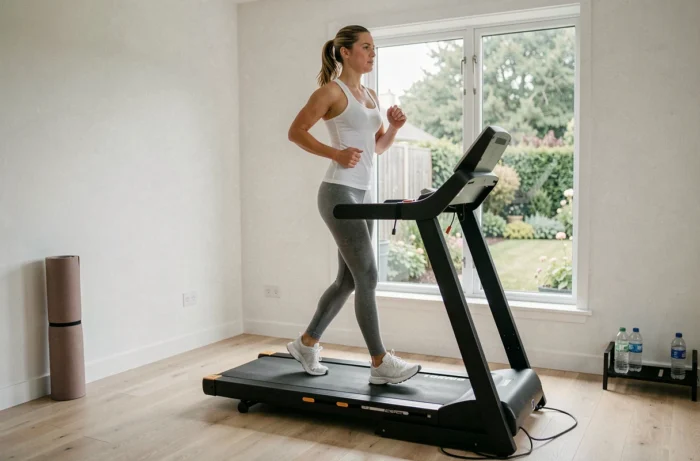
A vibrating floor, a neighbor below banging on the ceiling, and the treadmill ends up in the garage. Before comparing motors and running surfaces, it’s important to check if our home can support the machine. Choosing a treadmill for home use starts with very concrete constraints, often overlooked in product specifications.
Treadmills in old apartments: vibrations and nuisances to anticipate
In a Haussmannian building or a structure from the 1960s-1970s with wooden floors, the impacts of running are transmitted through the structure. The noise perceived by the neighbor does not come from the motor, but from the repeated foot strikes on the running belt. A decibel measurement displayed by the manufacturer does not predict the disturbance felt one floor below.
The choice of room is as important as the choice of treadmill. A room with a concrete slab floor is preferred over one with a suspended floor. If there’s no choice, a protective mat reduces vibrations without eliminating them. Running barefoot on the belt won’t change this: it’s the mass in motion that creates the wave.
You can compare reviews and technical specifications of different models on tapis-course.net to identify machines designed to limit impacts. Fast or inclined walking remains a realistic alternative when running might pose a neighborly problem, especially on a lightweight floor.

Motor power and running surface: what really changes training
It’s said everywhere that a powerful motor is needed. The real question is: powerful for what purpose? A motor sized for brisk walking won’t hold up for sustained running sessions. The advertised power often corresponds to a peak, not continuous operation.
Continuous motor power
It’s the continuous power (duty rating) that determines longevity and comfort of use. A motor that runs constantly close to its maximum capacity heats up, slows down, and wears out prematurely. For regular running, aim for continuous power well above your usual pace so that the motor never has to strain.
Running belt dimensions
The width of the belt affects safety as much as comfort. A natural stride deviates by a few centimeters with each step. On a narrow belt, you end up running tensely to stay centered, which alters biomechanics and increases the risk of missteps.
Length also plays a role: larger individuals or those who lengthen their stride at high speed need a more generous surface. These dimensions should be adapted to your morphology and the maximum pace you envision, not to the market average.
Incline and cushioning: two underestimated criteria
Motorized incline transforms a basic treadmill into a versatile training tool. Simulating a hill allows for cardio work at low speed, which reduces impacts (and noise). Running at low speed with a marked incline engages the posterior muscles more than running flat at a moderate pace.
For runners preparing for trails or hilly races, incline becomes a primary criterion. Models that also offer a decline (negative slope) add useful eccentric work for downhill, but these machines are rarer and more expensive.
Treadmill cushioning
A good cushioning system protects the joints, especially when accumulating kilometers. The difference between firm and soft cushioning is felt within the first few minutes.
- Too soft cushioning gives a floating sensation that destabilizes the stride and reduces energy return, like running in sand.
- Too hard cushioning replicates the stresses of asphalt without offering its natural variability, increasing the load on the knees and hips.
- The ideal is an adjustable or zoned system, firmer at the back (propulsion phase) and softer at the front (reception phase).
Folding treadmill: save space without sacrificing everything
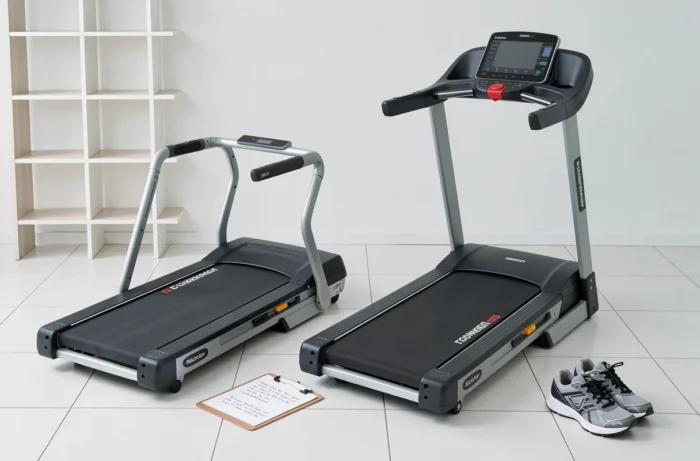
In an apartment or small house, floor space often dictates the final choice. Vertical folding treadmills free up space, but not all are equal in stability once unfolded.
Check the weight of the machine: a treadmill that is too light vibrates more and can move during running. The assisted hydraulic folding system prevents straining your back with each storage. A folding treadmill that weighs enough remains stable in use and can be stored effortlessly if the piston is well-sized.
The EN ISO 20957-6 standard, mentioned by the INRS, distinguishes usage classes. A device designed for occasional home use does not have the same robustness as a model intended for daily sessions. Checking this classification before purchase avoids unpleasant surprises after a few months.
Budget and frequency of use: making the right trade-offs
The price of a treadmill generally reflects the quality of the motor, the size of the surface, and the overall durability. Buying an entry-level model for running five times a week is setting up for a quick breakdown.
- For daily walking or occasional running, entry-level models fulfill their function if speed and duration limits are respected.
- For regular running training, upgrade the motor and cushioning, even if it means skipping the touchscreen or connected programs.
- For intensive use or shared among several household members, the robustness of the frame and long-term motor warranty take precedence over additional features.
The budget doesn’t stop at the purchase price. Consider maintenance (lubrication of the belt, replacement of wear parts) and electricity consumption, which varies according to motor power and frequency of use.
A well-chosen treadmill lasts for years. A poorly suited treadmill for its home or practice ends up on resale sites within months, with immediate depreciation. Taking the time to cross-check space, noise, and training frequency constraints before looking at technical specifications is the only method that truly works.