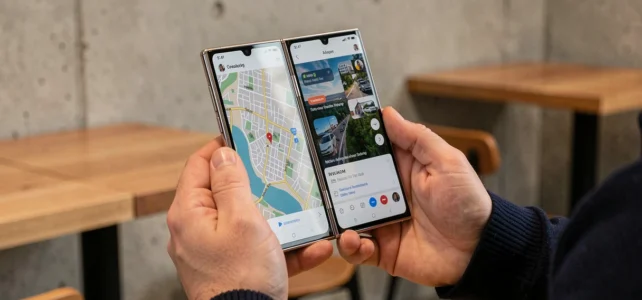
The Honor Magic V6 is a foldable smartphone launched in France since July 2026, starting at €2,299.90. With a thickness of 8.75 mm when folded and 4 mm when unfolded, weighing 219 grams, it approaches the dimensions of a classic phone while offering a large internal foldable display.
Silicon-Carbon Battery and Charging of the Honor Magic V6: What Really Changes
Most foldable smartphones suffer from a compromise on battery life. Their format requires smaller batteries than traditional models, often necessitating a recharge in the middle of the day.
The Magic V6 breaks this trend with a silicon-carbon battery of 6,660 mAh, the largest capacity observed on a foldable sold in Europe. Silicon-carbon technology allows for more energy storage in a reduced volume, which explains how Honor managed to fit such capacity into such a thin chassis.
Charging accompanies this battery with two power levels: 80 W wired and 66 W wireless. In practice, wired charging allows for recovering a significant portion of the battery during a short break, and the 66 W wireless charging remains fast enough to eliminate the daily dependence on a cable. As detailed in the information on Airnews, this combination of battery life and charging changes the way one can use a foldable on a daily basis.
IP68/IP69 Certification on a Foldable Smartphone: A First at This Level
Water and dust resistance has long been a weak point for foldables. The hinge and the fold of the screen create vulnerable areas that manufacturers struggled to protect.
The Honor Magic V6 boasts a dual IP68 and IP69 certification. IP68 guarantees prolonged immersion in fresh water. IP69 goes further: it certifies resistance to high-pressure and high-temperature water jets, a level of protection typically reserved for industrial equipment.
For a foldable smartphone, this dual certification means that the hinge and seals have been designed to withstand conditions far beyond a simple splash. It’s a concrete argument for those hesitant to invest in a foldable due to concerns about its fragility.
NanoCrystal Shield Coating
Honor adds a coating called NanoCrystal Shield, claimed to enhance the shock resistance of the external screen. According to the manufacturer, this treatment makes the surface significantly more resistant to scratches than the standard glass used on previous generations.
Camera Module of the Magic V6: Periscopic Telephoto and Dual Selfie Sensors
On a foldable, the camera module is often sacrificed for the sake of slimness. The Magic V6 takes a different approach with a triple rear sensor and two front cameras:
- 50 MP main sensor and 50 MP ultra-wide angle to cover common uses (landscapes, group scenes, low-light photos)
- 64 MP periscopic telephoto lens with 3x optical zoom, a component usually reserved for high-end traditional smartphones as it requires depth in the chassis
- Two 20 MP selfie sensors, one on each screen, allowing the use of the main rear sensor as a front camera using the external screen as a viewfinder
The periscopic telephoto lens deserves special attention. This type of optics uses a prism to bend light at a 90-degree angle, allowing for real optical zoom without increasing the thickness of the module. Integrating such a component into a foldable that is 4 mm thick (when unfolded) represents a notable engineering challenge.

6.52-Inch External Screen: Real Usage Without Unfolding
The first foldable smartphones offered narrow external screens, barely sufficient to read a notification. The external screen of the Magic V6 measures 6.52 inches, a size comparable to many traditional smartphones.
Several tests indicate that this screen is large and bright enough to make “classic phone” usage credible without unfolding the device. Web browsing, messaging, social media: most common tasks no longer require opening the phone.
The internal screen, on the other hand, offers a much larger surface suitable for productivity, video watching, or reading. The slight deformation at the fold remains perceptible to the touch according to some feedback, but it becomes less noticeable with use.
MagicOS 10 and Positioning Against the Galaxy Z Fold and iPhone
The Honor Magic V6 runs on MagicOS 10, Honor’s Android overlay. Several tests note that the software side lags behind the hardware level of the device. The interface works, but it sometimes lacks the polish and fluidity expected at this price point.
This is the point that divides opinions the most. The hardware competes with the Samsung Galaxy Z Fold, even surpassing it in battery life and water resistance. The software, however, has not yet reached the same level of maturity as One UI or iOS.
- Against the Galaxy Z Fold, the Magic V6 wins on battery, wireless charging, and slimness, but loses on software optimization and the foldable app ecosystem
- Against the iPhone, the comparison is less direct since Apple does not yet offer a foldable format, but the price of the Magic V6 places it in direct competition with the most expensive iPhone
- The launch offer at €1,699.90 narrows the gap and makes the equipment-price ratio more favorable during the promotional period
The Magic V6 represents a technically accomplished foldable on almost all hardware criteria. The silicon-carbon battery, dual IP68/IP69 certification, and periscopic telephoto lens place it among the most complete foldables available. The software maturity of MagicOS remains the main barrier for those comparing with Samsung or awaiting a potential Apple foldable. At €2,299.90, the entry price is high, but the launch price of €1,699.90 changes the game for early buyers.