
Your pool shows a correct chlorine level on the test strip, but the water remains cloudy or turns green within a few days. This discrepancy between the measurement and the visible result is a classic sign of water saturated with stabilizer. Cyanuric acid, present in most chlorine tablets, accumulates in the pool without ever degrading naturally. Beyond a certain threshold, it neutralizes the disinfecting effect of chlorine, rendering each treatment ineffective.
Diagnosis before treatment: the values that guide the decision
Before purchasing any products, a complete water analysis is essential. Testing only chlorine and pH is not enough when saturation is suspected.
Have you already noticed that the water remains cloudy despite a shock chlorine treatment? This is often because the stabilizer blocks the disinfectant’s action. Measuring the stabilizer level is the first step to avoid treating blindly.
Standard test strips (4 or 7 parameters) provide an approximate indication of the stabilizer. For a reliable result, a photometer at a pool store is more precise. The ideal stabilizer level is between 30 and 100 ppm. Beyond that, chlorine gradually loses its disinfecting power.
Several parameters must be measured simultaneously to make a true diagnosis:
- The pH, which must remain within a narrow range for chlorine to act correctly
- The TAC (total alkalinity), which stabilizes the pH and prevents drastic variations after each product addition
- The TH (hardness), which influences the formation of scale deposits and the turbidity of the water
- The stabilizer level (cyanuric acid), a true indicator of saturation
When looking to recover saturated pool water, this diagnostic step guides towards the right solution and avoids overdosing on chemicals.
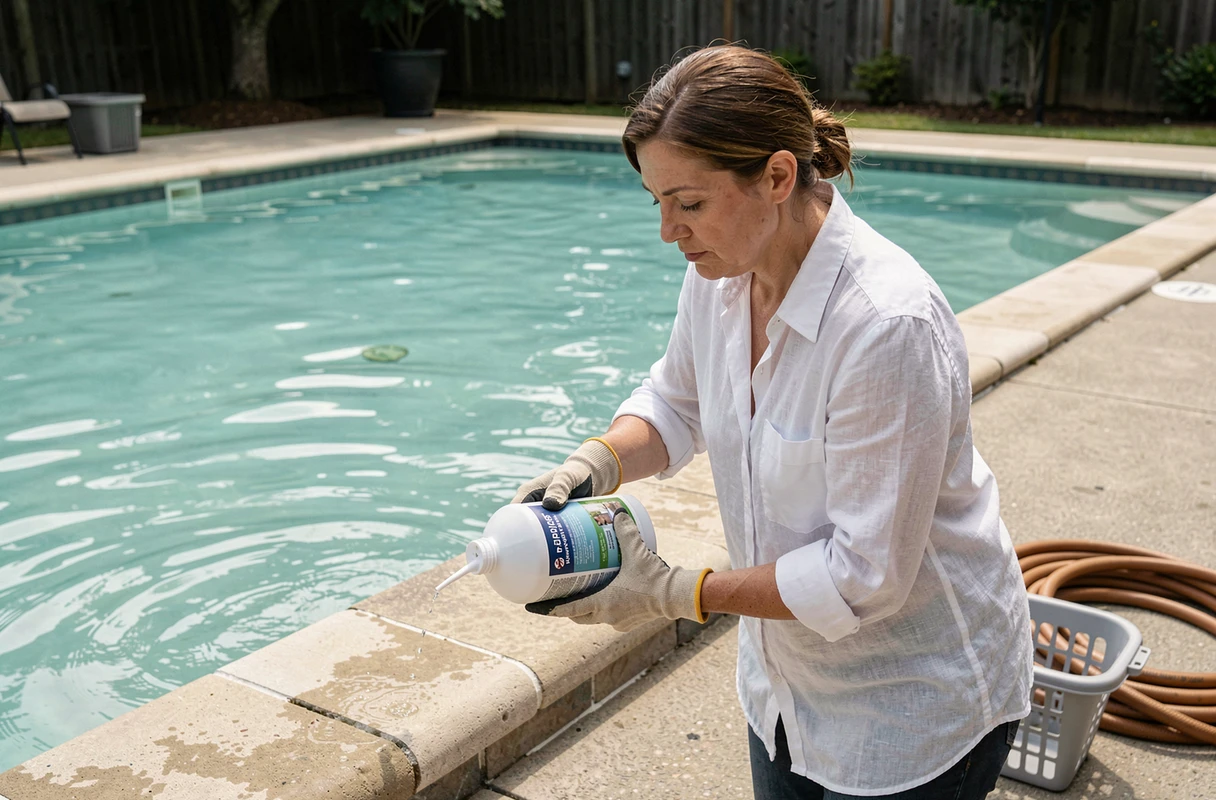
Partial dilution, shock treatment, or complete drain: choose according to the saturation level
There are three options for treating over-stabilized water. The right choice depends on the measured stabilizer level, the type of filter installed, and the amount of water you can afford to replace.
Partial dilution of the pool
When the stabilizer slightly exceeds the acceptable threshold, draining one-third of the pool and then refilling with fresh water is often enough to bring the level back to a zone where chlorine becomes active again. This method uses less water than a complete drain and preserves part of the existing chemical balance.
After partial refilling, the filtration must be restarted for several hours to homogenize the mixture, then a complete analysis should be done before adding chlorine.
Shock treatment without stabilizer
If the stabilizer level remains moderate but the water has already turned (visible algae, green or cloudy water), an unstabilized shock chlorine is the appropriate response. Using shock chlorine without cyanuric acid prevents worsening saturation. Calcium hypochlorite or diluted bleach serve this purpose.
Note: this treatment only works if the pH is corrected beforehand. A pH that is too high reduces the effectiveness of shock chlorine, even if unstabilized. This is why many shock treatments fail even when the dosage seems correct.
Complete drain
When the stabilizer reaches very high levels and the water no longer responds to any treatment, a complete drain remains the only reliable solution. It allows for a fresh start. This option consumes a significant volume of water, which poses a problem in regions subject to summer restrictions.
Before draining, check local regulations regarding the discharge of chlorinated water. Some municipalities impose a dechlorination period or prohibit direct discharge into the stormwater system.
Filter type and saturation: a link that conventional advice ignores
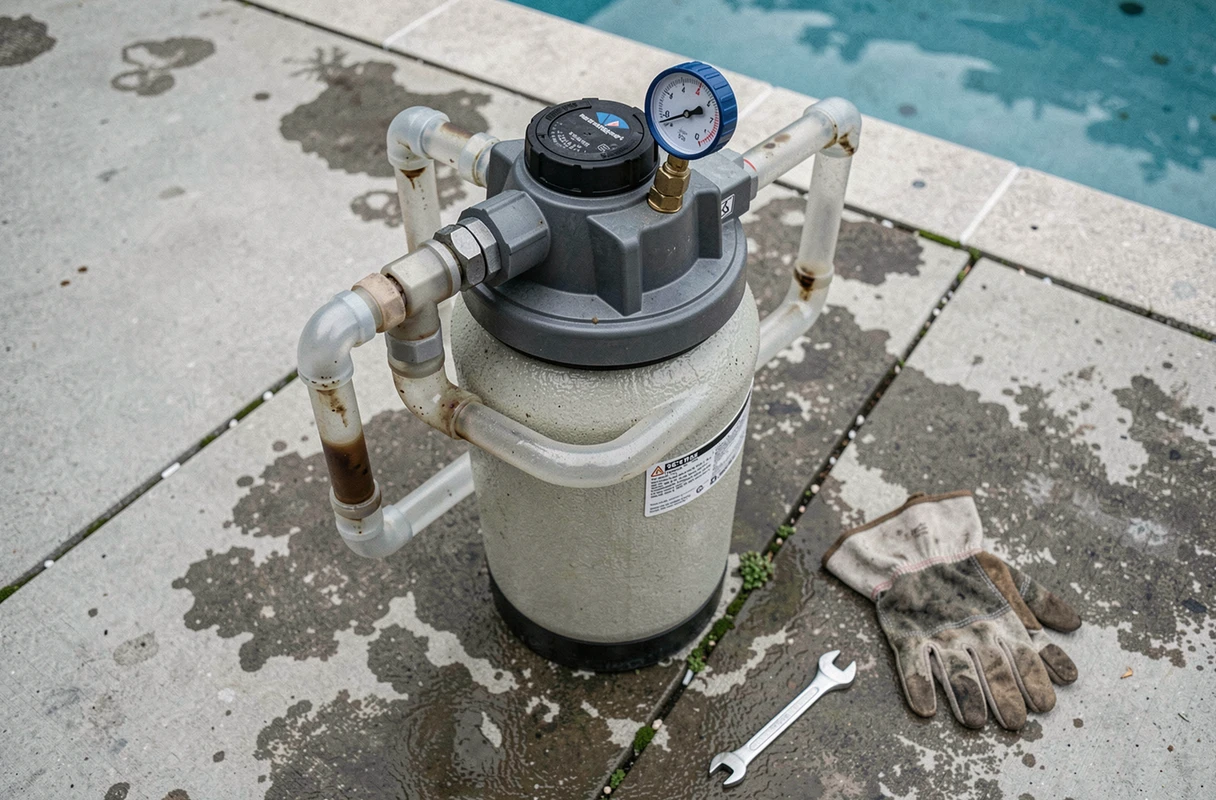
The filter media plays a concrete role in the speed at which a pool becomes saturated, and in the ease of recovery.
A standard sand filter retains particles but does not eliminate dissolved stabilizer. After a shock treatment, residues of dead algae and suspended matter quickly clog the sand. Insufficient backwashing after a shock chlorine treatment prolongs turbidity and gives the impression that the treatment did not work.
Finer filter media (recycled glass, zeolite) provide more thorough filtration of fine particles. They do not further reduce dissolved stabilizer, but they speed up the return to clear water after dilution or shock. The choice of filter media is not trivial when one has to perform multiple recoveries each summer.
Prevent over-stabilization without multiplying drains
The stabilizer accumulates because it does not degrade. Each stabilized chlorine tablet adds a dose of cyanuric acid that remains in the water indefinitely, even after evaporation and partial refilling.
Why does this detail matter? Because many owners exclusively use stabilized tablets throughout the season, thinking they are doing the right thing. After a few months, the stabilizer reaches a critical level without any visible signs appearing immediately.
Some habits significantly reduce the risk of saturation:
- Alternate stabilized tablets and unstabilized chlorine (calcium hypochlorite) according to the season and sunlight
- Perform a preventive dilution of 10 to 15% of the volume at the beginning of each season, before the stabilizer accumulates
- Analyze the stabilizer at least once a month during the swimming season, not just pH and chlorine
- Cover the pool at night to limit chlorine loss due to UV, which reduces the need for stabilized tablets
Alternating types of chlorine is the most effective lever to delay saturation without wasting water. A covered or semi-covered pool needs less stabilizer than a pool exposed to full sun all day.
Recovering saturated water remains a heavy operation. Anticipating the problem through regular monitoring of the stabilizer and a reasoned choice of treatment products prevents facing a forced drain in the middle of summer when water restrictions further complicate the situation.