
The hydraulic pressure of a mini excavator determines the force transmitted to the cylinders, the bucket, and the turret. A deviation of a few bars from the manufacturer’s specifications is enough to cause slow movements, overheating of the oil, or accelerated wear of the pump. Adjusting this pressure requires understanding the role of the pressure limiter, having a reliable pressure gauge, and following a progressive method.
Pressure limiter and relief valve: two components to distinguish
On most mini excavators, the hydraulic circuit includes a main pressure limiter and one or more secondary relief valves. The main limiter protects the entire circuit by setting the maximum pressure that the pump can generate. The secondary valves, on the other hand, protect specific sections (arm, boom, translation).
Confusing the two is the most common mistake. Acting on the main limiter changes the pressure of the entire system. Acting on a secondary valve only affects a specific cylinder or motor. Before any intervention, physically locate these two types of components on your machine using the manufacturer’s maintenance manual.
To deepen the understanding of the operating logic and associated techniques, the adjustment of hydraulic pressure on mini excavators relies on a clear understanding of this hierarchy between limiters and valves.
Pressure gauge and measurement point on the hydraulic circuit
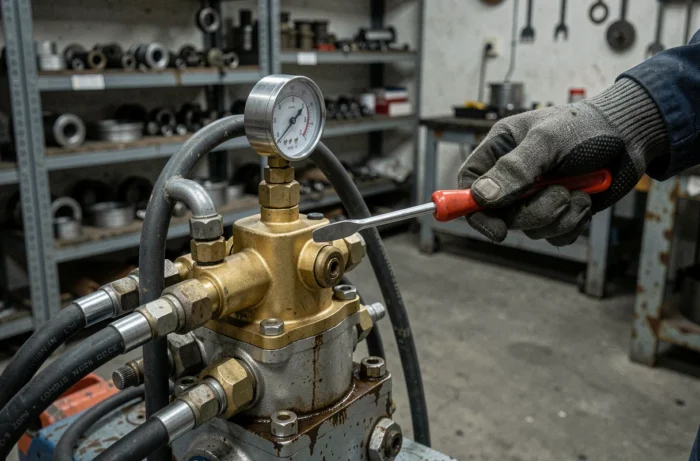
No reliable adjustment can be made without measurement. The hydraulic gauge connects to a test point provided by the manufacturer, usually located at the pump outlet or on the main distributor. Connecting the gauge to the wrong point skews the reading by several tens of bars.
Before connecting the instrument, stop the engine and release the residual pressure by operating the controls several times. This step prevents a spray of pressurized oil at the time of connection. Also, ensure that the gauge’s range covers the maximum pressure indicated in the machine’s manual: an undersized gauge risks being damaged, while an oversized gauge will provide an inaccurate reading.
Once the gauge is in place, start the engine and bring the oil to its operating temperature. The viscosity of the hydraulic fluid varies significantly with temperature, and a cold measurement does not reflect the actual pressure under working conditions.
Procedure for adjusting the pressure limiter on mini excavators
The adjustment is made with the engine running, oil at temperature, and the gauge connected. The method follows a precise order:
- Bring a cylinder to its limit (bucket closed or arm folded) to engage the main limiter and cause the maximum pressure in the circuit.
- Read the value displayed on the gauge and compare it to the setting pressure indicated in the manufacturer’s manual.
- If the value is too low or too high, turn the adjustment screw of the limiter in increments of a quarter turn maximum, then read the pressure again.
- Repeat the operation until the prescribed value is obtained, without ever exceeding the maximum pressure allowed by the manufacturer.
Turning the screw clockwise generally increases the pressure, while turning it counterclockwise decreases it. This convention may vary depending on the manufacturer of the limiter: always check the technical documentation.
Each modification must be followed by a new reading on the gauge. Adjusting by several turns at once risks exceeding the safety pressure of the circuit and may damage hoses, seals, or the pump itself.
Overheating and flow: two signals that reveal a poor adjustment
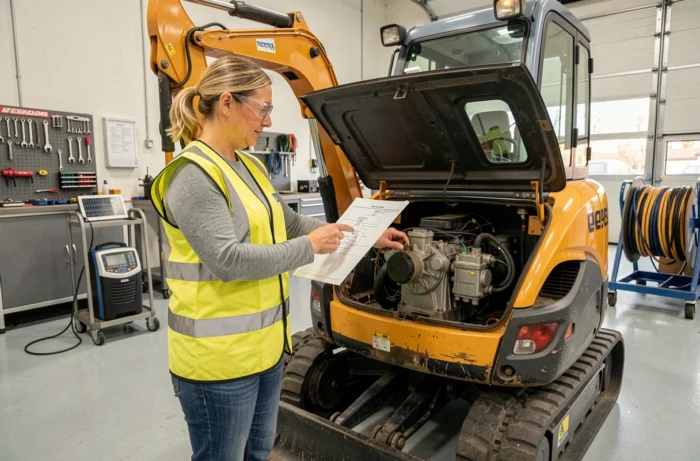
An adjustment that is too high puts the pump beyond its limits, leading to an abnormal rise in oil temperature. When the hydraulic fluid exceeds its operating range, it loses its lubricating properties. Seals harden, internal leaks increase, and flow decreases.
Conversely, an adjustment that is too low manifests as a visible loss of power in the movements of the arm and bucket. The machine seems “soft,” unable to dig or lift normally. The reflex to compensate by increasing the engine speed only increases fuel consumption without solving the underlying problem.
Manufacturers of recent mini excavators tend to calibrate pressures slightly below the theoretical maximums of the circuit. This approach prioritizes the longevity of components and reduces downtime due to leaks or overheating, especially for machines intended for rental.
Machine regulation 2023/1230: what a pressure modification changes
The European regulation 2023/1230 regarding machines will come fully into effect in 2027. One point deserves the attention of any operator who intervenes on hydraulic adjustments: significantly modifying the pressure compared to the original specifications may reclassify the machine as a “modified machine”.
In this case, the operator is treated as a manufacturer and must assume the associated obligations: risk analysis, updating technical documentation, compliance verification. This regulatory constraint reinforces the idea that an adjustment should never deviate from the values prescribed by the manufacturer without documented technical justification.
In practice, recalibrating the limiter to restore factory pressure after a drift is not a problem. Deliberately increasing the pressure beyond the original specifications to gain power, however, exposes one to legal as well as mechanical consequences.
The starting point remains the machine’s maintenance manual. Without this reference, any adjustment of the pressure on the hydraulic circuit of a mini excavator is approximate, with the risks that this entails for both the machine and the operator.