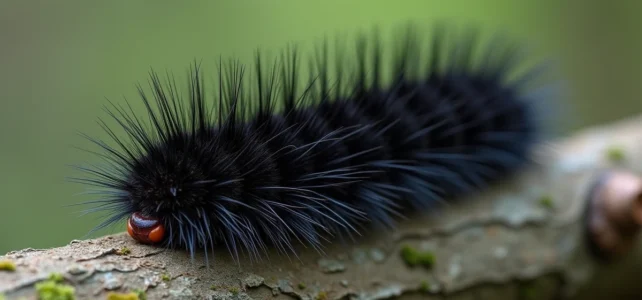
Faced with a black, hairy caterpillar discovered on a wall, trunk, or lettuce leaf, the first reflex is often to step back. The hairy black caterpillar actually encompasses dozens of different species, the vast majority of which pose no health risk. The problem lies less in the color or hairiness than in the almost systematic confusion with processionary caterpillars, the only ones whose hairs cause serious reactions.
Hairy black caterpillar or sawfly larva: a common mistake in the garden
Before even trying to identify the exact species, it is essential to eliminate a confusion that few guides address. Some black larvae observed on rose bushes, currant bushes, or hazel leaves are not butterfly caterpillars, but sawfly larvae, an insect of the order Hymenoptera (like wasps). This distinction matters because management methods and risk levels differ completely.
A lepidopteran caterpillar has at most five pairs of false abdominal prolegs. A sawfly larva has six or more. In the field, this detail can be verified with the naked eye if the larva is large enough: just count the pairs of soft legs located under the abdomen, behind the three pairs of true thoracic legs.
Behavior also helps. Sawfly larvae often line up along the edge of a leaf and raise the tip of their body in an S-shape when disturbed. Butterfly caterpillars rarely adopt this posture. To learn everything about the hairy black caterpillar, this first distinction already avoids a good number of incorrect identifications.
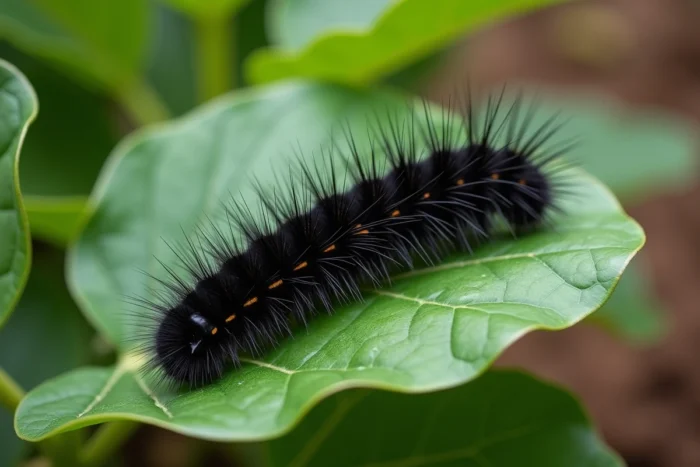
Host plant and behavior: two criteria more reliable than color
The black color alone does not allow for distinguishing between species. Most online guides focus on body color and hair length, but these traits vary according to the larval stage. The same species can appear dark brown in the third stage and distinctly black in the final stage.
The host plant as the first filter
Each species of caterpillar develops on a limited number of plants. This link between the larva and its host plant is the quickest identification criterion.
- A hairy black caterpillar found on oak suggests the Oak Moth (Lasiocampa quercus) or, in some cases, the Oak Processionary, which lives in dense colonies with silky nests.
- On brambles or low heather, the Bramble Moth (Macrothylacia rubi) is the most likely candidate: its caterpillar, brown-black with reddish hairs, is very common in France.
- On a pine or cedar, the presence of a characteristic white nest almost certainly indicates the Pine Processionary.
- On nettles, the black caterpillar with white spots and branched spines is generally that of the Peacock Butterfly (Aglais io), a common and completely harmless butterfly.
Gregarious behavior, a determining clue
Processionary caterpillars move in single file, head to tail. This procession behavior is rare among other hairy species. If the observed black caterpillar is alone, the likelihood that it is a processionary decreases significantly. On the other hand, a compact group on an oak branch with visible silk threads should raise caution.
Visible hairs and stinging micro-hairs: a health distinction to understand
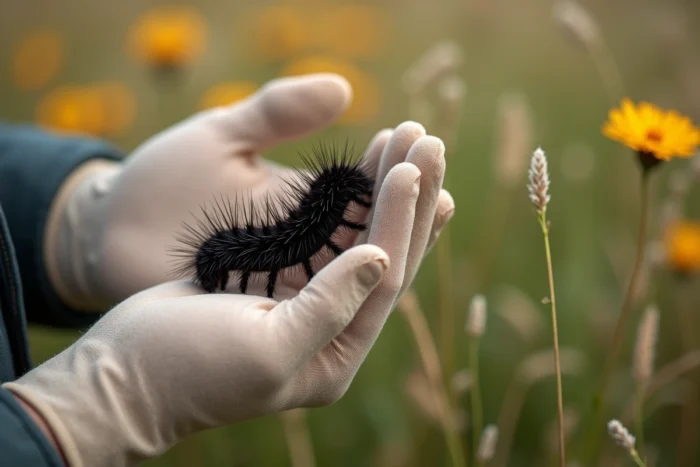
The “hairy” appearance of a caterpillar does not mean it is dangerous. The majority of hairy black caterpillars have defensive hairs that do not penetrate the skin and do not release any irritating substances. They can be handled without gloves, although caution is still advisable as a precaution.
The real risk comes from the stinging micro-hairs of processionaries. These hairs, invisible to the naked eye, measure a few tenths of a millimeter and are covered with barbs. They detach at the slightest contact, but also spontaneously due to the wind. They remain active in the environment for a long time, including in abandoned nests or on the ground, well after the caterpillars have left.
For a non-specialist observer, the field rule is as follows: never touch a hairy caterpillar living in a colony on a tree, especially if a silk nest is visible. Solitary black caterpillars or those in small groups on low plants present a much lower risk.
Risk for pets: underestimated indirect contacts
Dogs are the primary victims of contact with processionaries, often through ingestion or simply licking the ground. The micro-hairs settle on grass, patios, and clothing left outside. A dog that sniffs a contaminated area can develop tongue necrosis within hours.
The danger persists after the procession season, as the hairs remain in old nests and disperse with the wind. This indirect risk is regularly underestimated by pet owners.
Hairy black caterpillars that are not processionaries (Bramble Moth, Pine Hawk-moth, Peacock Butterfly) do not pose this type of danger to animals. The distinction between these species and processionaries therefore relies on the criteria already mentioned: host plant, gregarious behavior, presence of silky nests.
Head shape and larval stage: refining identification
When the host plant and behavior are not sufficient, the cephalic capsule (hardened head of the caterpillar) provides additional clues. In the Oak Processionary, it is black and shiny, wider than the first segment of the body. In the Oak Moth, the head is proportionally smaller and the same color as the body.
The larval stage complicates identification: young caterpillars of many species look alike. At the first and second stages, an Oak Processionary and a Brown-tail Moth can be almost identical. The available data do not always allow for a clear decision based on photos, especially with a shot taken from a distance or in low light.
In case of persistent doubt, the most reliable approach remains to note the plant on which the caterpillar is found, photograph the top and side of the animal, and then submit the image to a specialized entomology forum. Identifying the host plant narrows down the possibilities to two or three species, where color alone leaves dozens of potential candidates open.