
Choosing an engine for a Dax 125cc is not just about comparing technical specifications. Between the original Honda ST125 Dax, the SkyTeam blocks, and generic Chinese engines, the differences pertain as much to electronic management and administrative compliance as to torque or top speed. This article measures these differences point by point.
Administrative compliance of the Dax 125 engine: the overlooked trap of comparisons
Most guides compare torque, transmission, and riding sensations. They overlook a parameter that conditions the legal circulation of the vehicle: the correspondence between the installed engine and the registration certificate.
The installed engine must remain consistent with the engine code, displacement, net power, and type of fuel listed on the registration certificate. A discrepancy, even minor in appearance, can require an administrative update and a new reception of the vehicle. According to eplaque.fr (article updated on September 8, 2026), any inconsistency between these sections and the actual block in place exposes the owner to a refusal at the technical inspection.
The DREAL Auvergne-Rhône-Alpes goes further: replacing an engine that modifies power or fuel type is subject to a single reception (RTI). Prior approval from the manufacturer may be required, with tests on noise, emissions, and braking. A block sold as “plug-and-play” on a forum or specialized site does not guarantee automatic compliance.
Before looking for reviews on the SkyTeam Dax 125, check if the intended engine matches the data on your registration certificate; otherwise, the mechanical gain turns into an administrative headache.

Honda ST125 Dax vs. SkyTeam clones: a table of known characteristics
The Honda ST125 Dax and the SkyTeam replicas share a common visual heritage, but their mechanical architectures diverge on several points. The table below summarizes the available data.
| Criterion | Honda ST125 Dax | SkyTeam Dax 125 |
|---|---|---|
| Engine architecture | Single-cylinder 4-stroke, air-cooled, electronic injection | Single-cylinder 4-stroke, air-cooled, carburetor (depending on versions) |
| Emission standard | Euro 5+ (2025 model) | Variable depending on year and market |
| Gearbox | 4-speed | 4-speed (semi-auto or manual depending on version) |
| Electronic management | Honda PGM-FI injection | Absent or basic |
| RTI compliance in case of swap | Original block, no procedure | RTI potentially required if power or fuel differ |
The Honda PGM-FI electronic injection marks the main difference between these two families of engines. This system continuously adjusts the air-fuel mixture, resulting in more stable consumption and emissions compliant with Euro 5+ standards. SkyTeam blocks equipped with a carburetor offer simpler mechanics to maintain, but without this level of regulation.
Dax 125 engine and urban use: what the single-cylinder architecture changes in daily life
The air-cooled single-cylinder of the Dax 125 was not designed for pure performance. Its architecture prioritizes mechanical simplicity and reliability in urban use. Air cooling eliminates the coolant circuit, reducing the number of parts that can fail.
However, this simplicity comes at a cost in terms of versatility. On the highway or during prolonged climbs, an air-cooled single-cylinder reaches its thermal limits more quickly than a liquid-cooled block. For daily use in the city and on departmental roads, this compromise remains relevant.
Several elements deserve attention when choosing an engine for this type of use:
- The availability of spare parts: a Honda block benefits from the dealer network, while a SkyTeam or generic engine often requires online orders with variable lead times
- The type of transmission: a semi-automatic gearbox makes driving in dense urban areas easier, while a manual gearbox offers more control on open roads
- The compatibility with the existing frame: an engine with different mounting points requires adaptations that can affect the chassis geometry and, by extension, road handling
Routine maintenance and cost of ownership
A carbureted engine can be serviced with minimal tools. Cleaning the carburetor, adjusting the idle, and replacing filters remain accessible to an amateur mechanic. An electronic injection block requires diagnostic tools to read error codes and adjust parameters, which leads to a workshop visit.
This difference impacts the medium-term cost of ownership. The gains in consumption and regulatory compliance from injection partially offset the higher maintenance costs, but the calculation depends on annual mileage and the owner’s ability to perform basic operations themselves.
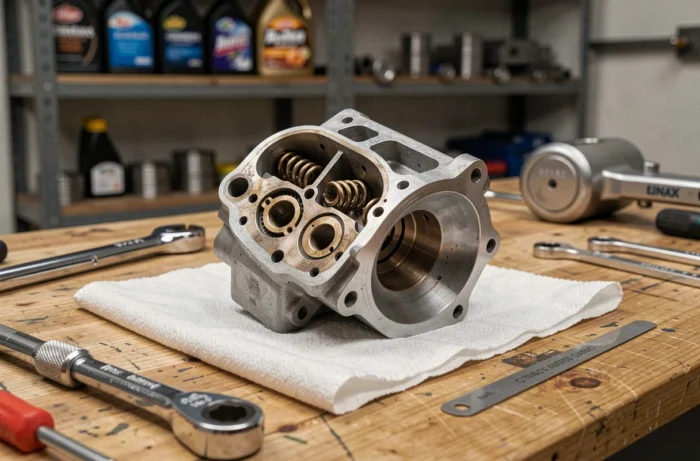
Engine swap on Dax 125: checks before getting started
Replacing the original block with a different engine remains a common practice in the Dax community. Specialized forums are full of feedback on successful swaps. But DREAL reminds that any modification to the engine can invalidate the certificate of conformity and require a reception before returning to circulation.
Points to check before a swap:
- The engine code of the new block must match the data on the registration certificate, or an RTI request must be submitted to DREAL
- Modifications affecting the exhaust, braking, or tires in addition to the engine change multiply the required inspections
- An engine whose power exceeds that listed on the registration certificate may reclassify the vehicle into a different category, with implications for insurance
The case of generic Chinese engines
Some blocks sold as compatible with Dax 125 come from manufacturers without an official network in France. The lack of certified technical documentation complicates the RTI procedure and makes administrative validation uncertain. The lower purchase price of these engines must be weighed against the risk of a reception refusal.
The choice of an engine for a Dax 125cc relies less on the quest for power than on a trade-off between mechanical simplicity, administrative compliance, and cost of ownership. The Honda ST125 block remains the safest solution from a regulatory standpoint. SkyTeam or generic alternatives open up customization possibilities, provided one considers the time and budget related to a potential single reception.