
The engine light of the Volkswagen Polo 5 is controlled by the vehicle’s electronic control unit. This unit continuously monitors the data reported by the engine sensors (temperature, pressure, air flow, combustion, emissions). As soon as a value goes outside the range defined by the manufacturer, the control unit records a fault code in the P0xxx format and lights up the warning on the dashboard. Understanding this mechanism allows you to distinguish between a minor alert and a problem that requires immediate stopping.
Solid or flashing engine light on Polo 5: two distinct levels of severity
The behavior of the light provides a reliable first indication. A continuously lit engine light signals a fault detected by the engine management system, but one that does not put the engine in immediate danger. The vehicle can generally still drive, sometimes with a slight loss of performance.
A flashing engine light indicates an active misfire. In this case, unburned fuel passes into the catalyst and risks damaging it due to overheating. On Polo 5 models equipped with the small 1.2 petrol engine, this scenario frequently appears in user feedback, with sudden power loss and marked jerks. Driving with a flashing light worsens the situation within a few kilometers.
To better identify the causes of the engine light on Volkswagen Polo 5, reading the fault code via a diagnostic tool remains the most direct method. The code points to the circuit or component involved, where the light alone only provides a binary signal.
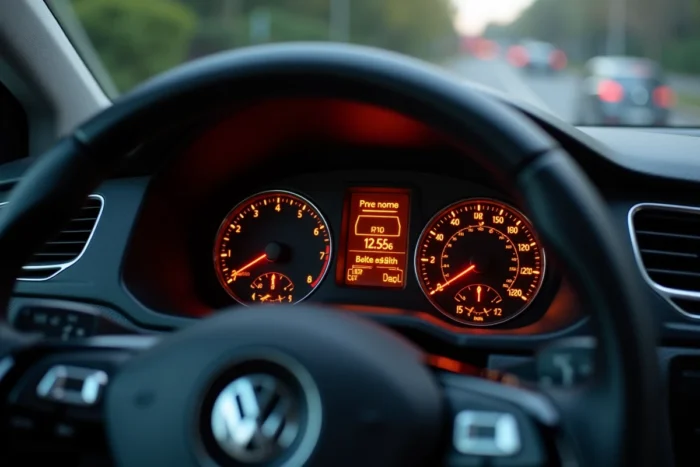
Ignition misfires and coils: the recurring fault of the 1.2 petrol
The 1.2 petrol engines of the Polo 5 (notably the 60 hp) are known to be sensitive to ignition misfires on one or more cylinders. The control unit detects a deviation in crankshaft speed between combustion cycles and records a code of type P030x, where the last digit identifies the affected cylinder.
The direct causes of these ignition misfires are few:
- Worn or dirty spark plugs, which no longer produce a sufficient spark to properly ignite the air-fuel mixture.
- Faulty ignition coils, a fragile component on this engine. Replacing just one coil is sometimes enough, but since wear is often uniform, replacing the entire set prevents close recurrences.
- A stuck or clogged injector, rarer on petrol versions but possible after high mileage or poor quality fuel.
A recurring testimony on specialized forums illustrates the pattern well: engine light on the highway, power loss, entering limp mode. After diagnosis at Volkswagen, a combustion misfire on cylinder 3 was resolved by replacing the spark plugs and coils with manufacturer parts, accompanied by an engine control unit update.
Polo 5 1.6 TDI: EGR valve and pollution circuit clogging
On the 1.6 TDI diesel versions, the profile of failures changes. The Siemens/Continental common rail injection system that equips these engines is sensitive to clogging, particularly in urban use with repeated short trips.
The clogged EGR radiator is a classic fault on this engine. The EGR valve recirculates a portion of the exhaust gases back to the intake to reduce nitrogen oxide emissions. When the circuit clogs, the recirculation flow becomes erratic. The control unit detects the anomaly, lights up the engine light, and may place the vehicle in limp mode with significant power limitation.
The combination of the engine light on plus the flashing preheating light, associated with a power loss, constitutes a nearly characteristic signal of this problem on Polo 5 TDI. Specialized garages report that this fault recurs frequently on this model.
Particulate filter and short trips
The particulate filter (DPF) normally regenerates automatically during sustained driving phases. Exclusive urban use prevents this regeneration from completing. A saturated DPF triggers the engine light and limits power. On the Polo 5 TDI, prolonged driving at medium speed on a fast lane may be enough to initiate a regeneration, but a heavily clogged DPF requires workshop intervention.

OBD2 diagnostics on Polo 5: reading fault codes yourself
The widespread availability of consumer OBD2 tools has changed how Polo 5 owners approach the engine light. A Bluetooth dongle plugged into the OBD port (located under the steering wheel) and an app like Easy OBD Tools allow you to read the fault codes recorded by the control unit.
This reading helps to differentiate a minor pollution fault from an ignition or injection problem even before making an appointment at the garage. A code P0401 (insufficient EGR flow) does not require the same urgency as a P0300 (multiple ignition misfires).
The tool also allows you to erase a fault code after intervention. If the light comes back on after erasure, the problem persists and requires a thorough diagnosis. A light that stays off after erasure and a few hundred kilometers confirms that the repair has effectively addressed the cause.
Limits of self-diagnosis
A fault code identifies a circuit or symptom, not always the part to be replaced. A code P0171 (too lean mixture) can come from an air leak at the intake, a faulty mass airflow sensor, or a worn fuel pressure regulator. The code guides the search, but the final diagnosis often requires real-time value measurement or an actuator test that only professional equipment can provide.
Polo 5 engine light and EPC light: when both light up together
The EPC (Electronic Power Control) light sometimes accompanies the engine light on Volkswagens. This combination signals that the control unit has detected a fault that directly affects the electronic management of power. The motorized throttle, the accelerator pedal sensor, or the boost pressure sensor (on turbo versions) are among the components that can trigger this double illumination.
When both lights illuminate simultaneously, the vehicle almost systematically enters limp mode. The available power drops significantly, and the engine speed may be limited. This behavior is a protection programmed by Volkswagen to prevent worsening an ongoing fault.
The Polo 5 remains a vehicle whose engine management system clearly communicates its anomalies, provided you know how to interpret its signals. A solid light allows time to organize a diagnosis. A flashing light requires a quick stop. And in all cases, reading the fault code transforms an ambiguous warning light into actionable information.