Bright objects filmed in the night sky, unexplained noises captured in abandoned buildings, increasingly documented testimonies by official organizations: the paranormal is no longer limited to urban legends. Unexplained phenomena are now subject to institutional monitoring that changes the way they are analyzed.
Unidentified Aerospace Phenomena: What Europe is Really Monitoring
You have probably heard about UAP (Unidentified Anomalous Phenomena) in an American context. What mainstream media rarely mention is that the European Commission has also been monitoring these phenomena since at least 2023.
The European approach is distinguished by its framework. Brussels treats UAP as a space security and observation capabilities issue, not as a hunt for extraterrestrials. The goal is concrete: to improve sensors and monitoring systems to better distinguish space debris, natural phenomena, and genuinely unexplained cases.
This distinction is fundamental. When an unidentified object appears on military radar, the first question is not “Is it an alien craft?” but “Are our instruments accurate enough to identify what it is?”. Several European media outlets, including Euronews, documented this approach in August 2026. Finding information on Paranormal News allows you to follow these developments over the weeks.
GEIPAN: The French Unit Investigating Aerial Paranormal Phenomena
In France, the monitoring of unidentified aerospace phenomena is conducted by GEIPAN, a unit attached to CNES (National Center for Space Studies). This service has existed for several decades, but its recent developments are little known to the general public.
Since January 15, 2024, GEIPAN has been led by Frédéric Courtade. Under his leadership, the service has strengthened its analytical tools and updated its statistics in 2026. GEIPAN’s work relies on a rigorous method:
- Each report of an aerial phenomenon is recorded, classified, and analyzed with meteorological, radar, and astronomical data
- Cases are categorized, from the most easily explainable (satellites, lanterns, atmospheric reflections) to those that remain unexplained after a thorough investigation
- Results and databases are accessible to the public, which distinguishes GEIPAN from many equivalent organizations worldwide
The majority of reports receive a rational explanation. Cases classified as truly unexplained represent a minority fraction of the total, but it is precisely those that fuel the most fascinating investigations.
What makes GEIPAN unique is its transparency. Unlike classified Pentagon programs, the French service publishes its data. A citizen can consult observation sheets, analysts’ conclusions, and the elements that led to classifying a case as unexplained.
Deepfakes and Paranormal Videos: The Digital Trap That Blurs Investigations
Recent paranormal news highlights a growing problem: the creation of false phenomena by artificial intelligence. In 2026, several viral videos presented as evidence of supernatural phenomena turned out to be deepfakes.
A telling example: a video showing an “inhuman creature” filmed on a rooftop circulated massively on social media. Analysis revealed it to be an AI creation. Another case, involving a supposed supernatural phenomenon filmed during a funeral, also turned out to be a deepfake.

Why is this a problem for paranormal investigators? Because every viral fake that circulates makes the sorting work more difficult and discredits authentic testimonies that deserve serious analysis. Organizations like GEIPAN must devote time and resources to eliminate digital fabrications before they can even examine a case.
Differentiating a Real Testimony from a Fabrication
Here are some practical tips for evaluating a video presented as paranormal:
- Check the original source: a video reshared without an identifiable author is suspicious
- Look for inconsistencies in lighting, shadows, or movements, typical signs of editing or AI generation
- Consult specialized verification sites before sharing, as fact-checking platforms regularly address these contents
- Be wary of videos that appear simultaneously on multiple accounts without a publication history on the subject
Ghost Stories and Poltergeists: What Still Fuels Field Investigations
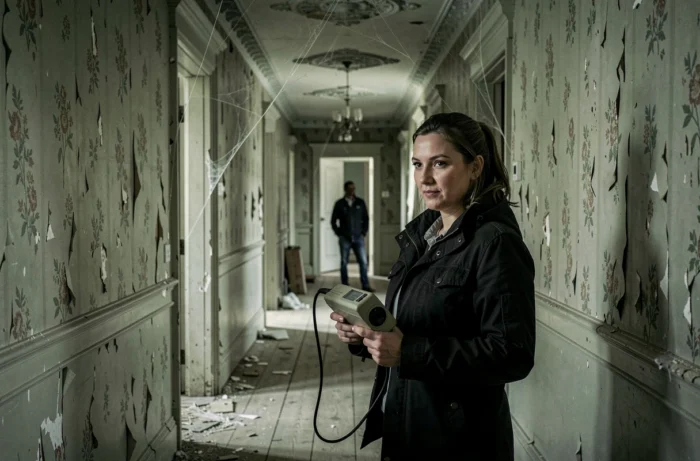
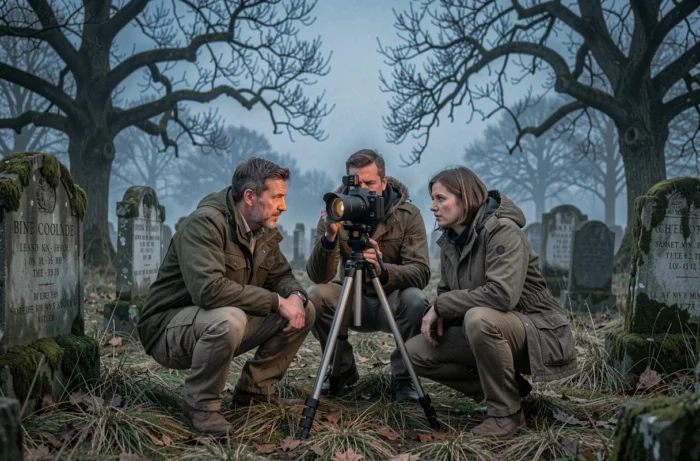
Despite the rise of digital media, field investigations into haunting and poltergeist phenomena continue to attract investigation teams across France and beyond. Accounts of haunted places, testimonies of unexplained episodes in old houses, and local legends provide a constant foundation for investigators’ activities.
What has changed in recent years is the equipment. Thermal sensors, high-sensitivity audio recorders, and night vision cameras have become accessible to the general public. This democratization has multiplied content, with investigation episodes published weekly on platforms like YouTube.
The channel Enquêtes Paranormales, for example, accumulates episodes documenting investigations in reputedly haunted locations. The format combines storytelling, audio capture, and nighttime exploration. This type of content fuels a persistent interest, driven by a new generation curious about unexplained phenomena.
The paranormal in 2026 stands at a crossroads. On one side, institutions like GEIPAN or the European Commission bring unprecedented analytical rigor to unidentified aerial phenomena. On the other, the proliferation of deepfakes forces every enthusiast to develop a critical eye on visual evidence. The most convincing investigations are those that combine corroborated testimonies, instrumental data, and methodological transparency.