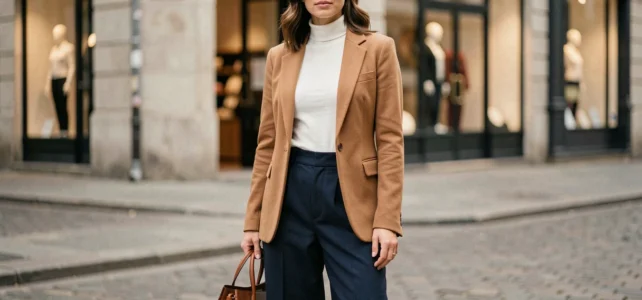
Wearing fewer clothes, but wearing them better: this is the shift that fashion is taking in France. Purchase volumes are declining, buying frequency is decreasing, and a majority of households report wanting to reduce their clothing budget. This context reshapes fashion trends and style advice around a simple principle: every piece in the wardrobe must justify its place.
Textile regulation in France: what concretely changes your wardrobe
Have you noticed that some brands now display an “environmental score” on their labels? This is not a marketing argument; it is an obligation that is being gradually implemented.
Since 2022, the destruction of unsold textiles is prohibited in France. Brands can no longer throw away their stock: they must donate, recycle, or sell it at a reduced price. Starting from September 1, 2026, a specific penalty targets ultra-fast fashion, those circuits that produce collections at a weekly pace.
At the European level, a regulation adopted in February 2026 extends this destruction prohibition logic to large clothing companies starting in July 2026. Since January 1, 2025, it is even prohibited in France to throw clothes in household waste: they must be dropped off at dedicated collection points.
These rules have a direct effect on the collections available in stores. Brands are offering more sustainable fabrics, cuts less tied to a micro-season, and pieces designed to last several years. Building a modern style today also means taking into account this regulatory framework that favors quality over quantity.
To keep up with these developments and find concrete outfit ideas, Point Contre Point’s fashion section regularly analyzes these topics from a practical angle.

Trendy colors and prints: bet on three palettes rather than ten
Accumulating seasonal colors no longer works when buying less. The successful approach: choose two or three shades that combine with each other and build your looks around this core.
Blackcurrant purple, the key color of the season
This deep shade, halfway between burgundy and plum, is making its mark on runways and in shop windows. It works equally well on a structured jacket as it does on fluid trousers. Its advantage: it naturally pairs with beige, off-white, and black, three colors likely already present in your wardrobe.
Butter yellow, a legacy of spring-summer
Less saturated than a bright yellow, butter yellow remains wearable in the fall in the form of accessories or lightweight pieces. A butter yellow blouse tucked under a navy blazer creates a sharp contrast effortlessly.
Limiting your color palette simplifies outfit choices every morning and reduces impulsive purchases. Three well-chosen colors generate more combinations than a dozen mismatched shades.
Key cuts and pieces: the wardrobe that transcends seasons
Fashion trends for 2026 converge towards loose silhouettes at the bottom and fitted at the top, or vice versa. This play of proportions gives structure without rigidity.
- The wide pant (barrel or wide-leg type) is gradually replacing the slim fit. Worn with a marked belt at the waist, it elongates the silhouette regardless of body type.
- The short colored jacket, worn open over a plain t-shirt, serves as a signature piece. It replaces the traditional oversized blazer when seeking a more assertive style.
- The midi dress, straight or slightly flared, works alone in summer and with boots or a trench in fall. It is the most versatile piece in a modern women’s wardrobe.
Why these specific cuts? Because they do not depend on a micro-trend. A well-cut wide pant remains wearable for three to four years. A good-quality short jacket transcends seasons without looking dated.
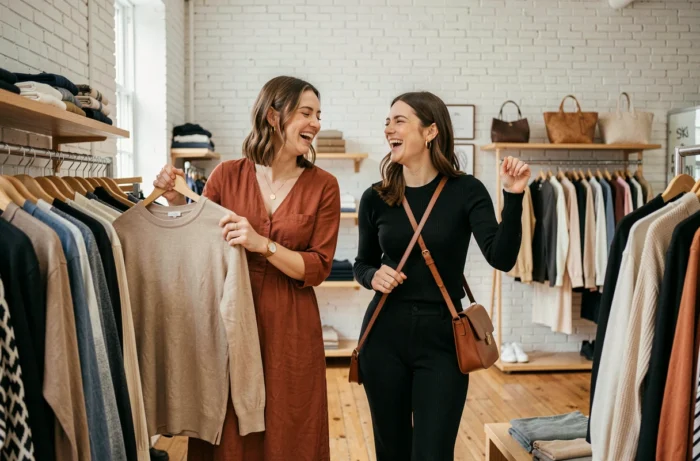
Connected ethical fashion: check before you buy
The traceability of clothing is no longer reserved for high-end brands. Apps now allow you to scan a label to check the environmental data of the product: origin of materials, place of manufacture, estimated carbon footprint.
This transparency transforms the way to build a style. Before buying a piece, you can check if the fabric is certified, if the dyeing meets certain standards, or if the brand has audited its factories. The “unique style” becomes a documented style.
In practical terms, this means that two visually identical dresses can have very different profiles. One made locally with traceable cotton, the other from an opaque supply chain. The price alone is no longer enough to assess the quality of a garment.
Building coherent looks with fewer pieces
Having a modern style does not come from multiplying outfits. It relies on the ability to combine a limited number of clothes into varied looks.
- Identify five key pieces in your wardrobe (one pair of pants, one skirt or dress, two tops, one jacket) and ensure they all work together.
- Add just one strong accessory per outfit (contrasting belt, colorful bag, visible jewelry) to create a difference without multiplying purchases.
- Test combinations before going out: taking a photo of your outfit allows you to see what really works and eliminate combinations that don’t hold up.
This selection work takes a bit of time at first, but it simplifies daily life sustainably. Fewer choices in the morning, less frustration in front of the closet, and a style that is more readable to others.
Current fashion trends do not require a complete renewal. They invite you to rethink what you already own, to fill gaps with durable pieces, and to treat each garment as an investment rather than a disposable purchase. The regulatory framework pushes in this direction, digital tools facilitate checks, and narrowed palettes make style more accessible. The key is to apply these principles to your own wardrobe, piece by piece.