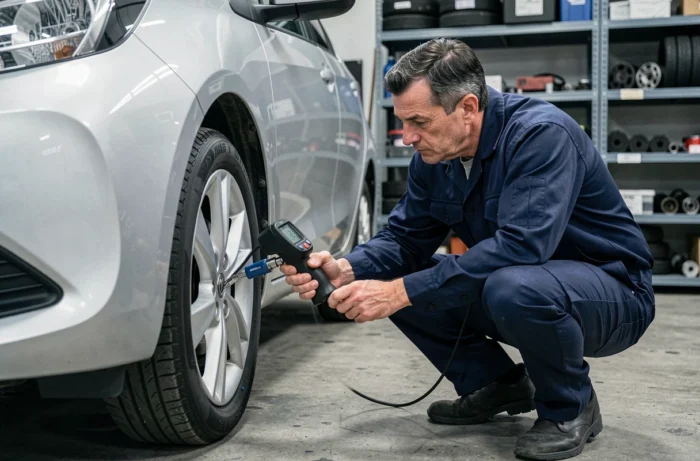
The tire pressure of a Toyota Yaris hybrid does not depend on the hybrid engine itself, but on the tire size mounted on the vehicle. Toyota applies the same inflation values for both a thermal Yaris and a hybrid Yaris equipped with the same tires. This clarification, confirmed in the Toyota maintenance guides updated in 2026, prevents the search for a hypothetical “special hybrid” pressure that does not exist.
Why tire size determines pressure and not engine type
On the Yaris IV (produced since 2020), the hybrid 1.5 version with 116 hp shares its platform and running gear with the gasoline version. The extra weight from the hybrid battery remains marginal in this city car segment, insufficient to justify a pressure difference.
What actually modifies the recommended pressure is the change from a 15-inch rim to a 16 or 17-inch rim. A wider tire with a lower profile absorbs loads differently, hence the distinct inflation values for each size.
To learn everything about the tire pressure of the Toyota Yaris hybrid, you must first identify the exact size printed on the sidewall of the tire before consulting a table of values.
Recommended pressures by tire size on Yaris hybrid
Here are the values published by Toyota for the Yaris IV under normal load, expressed in bar. They apply equally to both hybrid and gasoline versions.

| Size | Front (bar) | Rear (bar) | Front loaded (bar) | Rear loaded (bar) |
|---|---|---|---|---|
| 185/65 R15 | 2.3 | 2.2 | 2.5 | 2.4 |
| 195/55 R16 | 2.2 | 2.0 | 2.4 | 2.3 |
| 205/45 R17 | 2.2 | 2.0 | 2.4 | 2.3 |
The “loaded” column corresponds to a vehicle occupied by four or five passengers with luggage. For daily use with one or two occupants, the normal load values are sufficient.
17 and 18-inch tires on recent models
Since the 2023-2024 models, sizes 205/45 R17 and even 205/40 R18 appear in Toyota configurators as recommended sizes, no longer just as optional accessories. Each new size requires an adapted pressure: inflating a low-profile tire with the pressure intended for a 185/65 R15 would be a mistake.
The label affixed to the driver’s door frame remains the primary reference. It indicates the pressures in kPa and psi for the approved sizes on your specific vehicle.
Tire pressure check on Toyota Yaris hybrid: method and frequency
A monthly cold check is the recommendation from Toyota’s maintenance guides. “Cold” means that the vehicle has not been driven for at least two hours, or less than three kilometers at low speed.
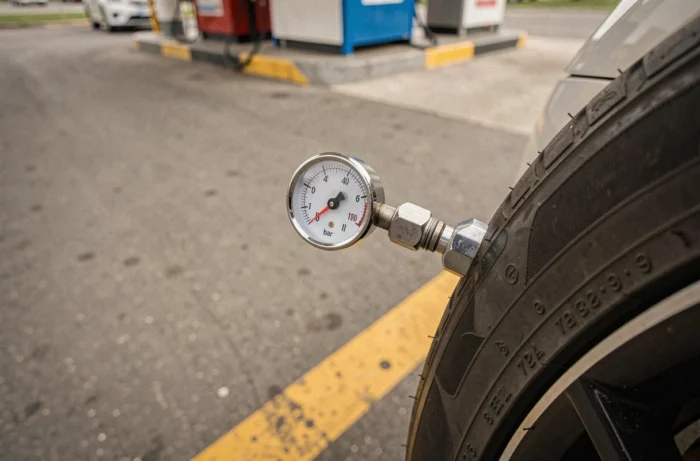
- Remove the valve cap and apply the gauge tip or the inflation terminal at the gas station, without letting any air escape
- Compare the reading with the value on the door frame label, not with a generic value found online
- Adjust the pressure if the difference exceeds 0.1 bar, by adding or releasing air in short bursts
- Replace the valve cap firmly to protect the TPMS sensor mechanism
Never adjust the pressure when hot: the heat generated by driving increases the pressure by a few tenths of a bar, which skews the reading.
Resetting the direct pressure sensor (TPMS)
The Yaris IV hybrid uses a direct pressure sensor integrated into each valve. After adjusting the pressure or changing tires, the TPMS light may remain on until the system has been reset.
The procedure goes through the vehicle’s multifunction screen: “Vehicle Settings” menu, then “TPMS”, then “Initialize”. Then just drive for a few minutes for the system to recalibrate the four sensors. If the light persists after about ten kilometers, the problem is likely due to a faulty sensor or a slow leak.
Concrete consequences of a pressure discrepancy on a hybrid city car
On a hybrid Yaris, even moderate under-inflation has a measurable impact. According to ADEME, an under-inflation of 0.5 bar increases consumption by 2.4%. On a vehicle designed to minimize its consumption through hybridization, this loss negates part of the technological benefit.
The effect on braking is even more concerning. According to Michelin, a pressure difference of one bar increases the braking distance on wet roads by about eleven meters. On a lightweight city car with reduced tire contact area, this increase represents a significant risk in urban settings.
Over-inflation poses other problems: concentrated wear in the center of the tread, more pronounced bouncing on road irregularities, and loss of grip in corners. Adhering to the manufacturer’s value within 0.1 bar remains the best compromise between tire longevity, comfort, and safety.
Tire pressure is one of the few maintenance tasks that can be performed without specialized tools or a workshop appointment. On a hybrid Yaris, five minutes a month at an inflation station is enough to preserve the consumption gains promised by the hybrid powertrain and to maintain braking distances in line with the vehicle’s original performance.