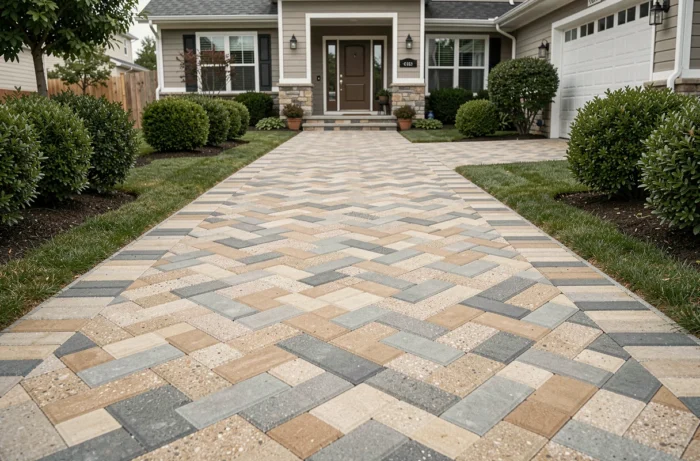
The concrete paver for driveways is defined as a molded block, vibrated under pressure, whose performance directly depends on its composition and compliance with specific technical standards. Before relying on colors or laying patterns, the choice is based on mechanical and regulatory criteria that determine the durability of the surface for several decades.
Standard NF EN 1338: the technical criterion that catalogs do not detail
The majority of product sheets mention freeze resistance without specifying what guarantees it. The NF EN 1338 standard sets measurable thresholds that allow for an objective comparison of two concrete pavers.
This standard specifically regulates water absorption, capped at around 6%. A paver that exceeds this threshold accumulates more moisture within its mass. During freeze-thaw cycles, the trapped water expands and causes surface flaking known as spalling. On a driveable path, where vehicle traffic increases stress, these degradations can sometimes appear as early as the second winter.
The standard also imposes requirements for compressive strength and abrasion resistance. To choose a concrete paver for a driveway that can genuinely withstand vehicle traffic, checking for the NF EN 1338 mention on the manufacturer’s technical sheet remains the most reliable action. A paver compliant with this standard has undergone laboratory tests for its mechanical performance and freeze resistance, distinguishing it from a decorative product without certification.
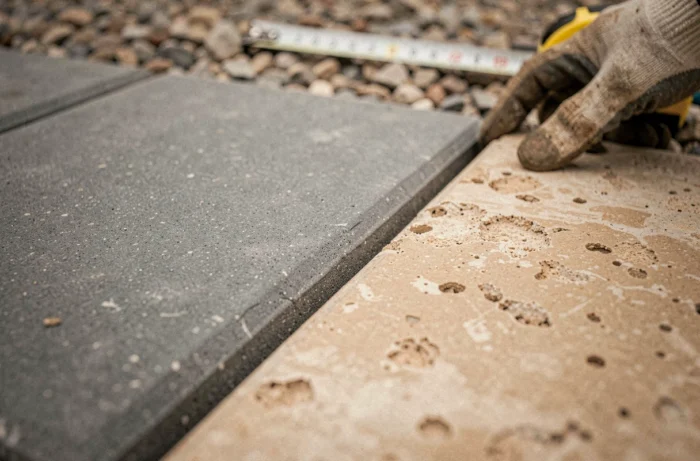
Thickness and format of concrete pavers according to the type of driveway
The thickness of a concrete paver is not a matter of aesthetic preference. It determines its ability to withstand loads without cracking or tipping under traffic.
Pedestrian walkway or garden path
For a pathway reserved for pedestrians, a moderate thickness is sufficient. The paver experiences little flexing, and the supporting structure (compacted sand bed on gravel) absorbs the load. The format can then prioritize aesthetics: rectangular pavers in staggered laying, small squares in opus, or elongated formats to create a perspective effect.
Driveable path or garage entrance
As soon as a vehicle regularly circulates, a greater thickness and an interlocking format are required. Interlocking pavers distribute loads among neighboring blocks, which limits localized settling. A manufacturer of driveable interlocking pavers recommends checking that the product explicitly bears the NF EN 1338 mention, specifically for areas subjected to vehicle traffic.
The choice of format also influences long-term maintenance. Pavers that are too small on a garage driveway multiply joints and create more weak points. Pavers that are too large without a fitting system risk moving under repeated maneuvers.
Surface finishes and aesthetic appearance of a concrete paver
Molded concrete now allows for finishes that imitate natural stone, weathered granite, or sandstone. Three main families of finishes stand out:
- The smooth finish, obtained through classic molding, gives a contemporary and uniform appearance. It facilitates cleaning with a water jet but can become slippery in rainy weather if it does not include a non-slip treatment.
- The shot-blasted or bush-hammered finish reproduces an irregular grain, similar to cut stone. This texture improves grip and better masks dirt on a heavily trafficked path.
- The aged (or tumbled) finish rounds the edges of the paver to simulate wear over time. It is suitable for rustic garden layouts, but the rounded edges slightly complicate the laying process and widen the joints.
The color throughout the mass, as opposed to a surface coloration, ensures that the paver retains its color even after abrasion. A paver tinted only on the surface loses its appearance within a few years on a driveable path. This point deserves to be checked before purchase.
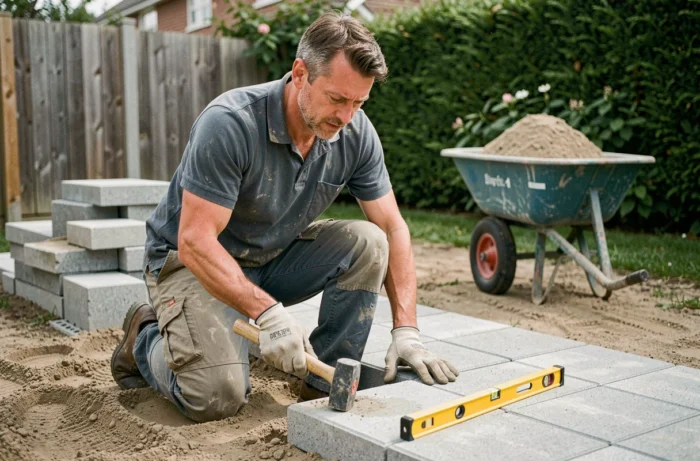
Drainage concrete paver: management of rainwater and regulations
Permeable concrete pavers constitute a distinct category. Their porous structure or widened joints allow rainwater to infiltrate directly into the soil, instead of directing it to the sewage system.
This approach aligns with the concept of sponge city, which aims to reduce urban runoff to limit flooding and recharge groundwater. Several municipalities now encourage the use of permeable surfaces in development projects, including for private individuals.
For a residential driveway, the drainage paver offers a tangible advantage: it eliminates the formation of puddles and reduces the need for gutters or drainage pits. The trade-off is specific maintenance. The pores or drainage joints can become clogged with fine soil particles, sand, or plant debris. Periodic cleaning, by vacuuming or mechanical sweeping, maintains the infiltration capacity.
Not all drainage pavers are suitable for vehicle traffic. Some permeable models are designed solely for pedestrian areas. It is essential to check the mechanical resistance class of the product if the driveway accommodates vehicles.
Joints and bedding: what happens beneath the paver
The best-chosen concrete paver will not last without an appropriate bedding structure. Two elements condition the stability of the whole:
- The stabilized sand bedding (sand-cement mix) provides a rigid base that prevents the pavers from sinking unevenly. An unstabilized sand bed is suitable for pedestrian areas but deforms under the weight of a vehicle.
- The jointing, done with fine sand or polymer sand, locks the pavers laterally. Polymer sand hardens upon contact with water and resists better to washout from rain, reducing the frequency of re-jointing.
- The foundation of compacted gravel, beneath the bedding, must be sized according to the nature of the soil and the expected load. A clayey soil, which swells and shrinks with moisture, requires a thicker layer of gravel than naturally draining sandy soil.
Neglecting the foundation transforms a new driveway into a wavy surface after a few seasons. The concrete paver remains intact, but the underlying soil has shifted, creating dips and bumps that are difficult to correct without complete removal.
The last point to consider is the drainage slope. Even with drainage pavers, a minimum slope directed towards an outlet prevents water stagnation on the surface during intense rain episodes. This slope should be planned from the earthworks, not after the laying.