
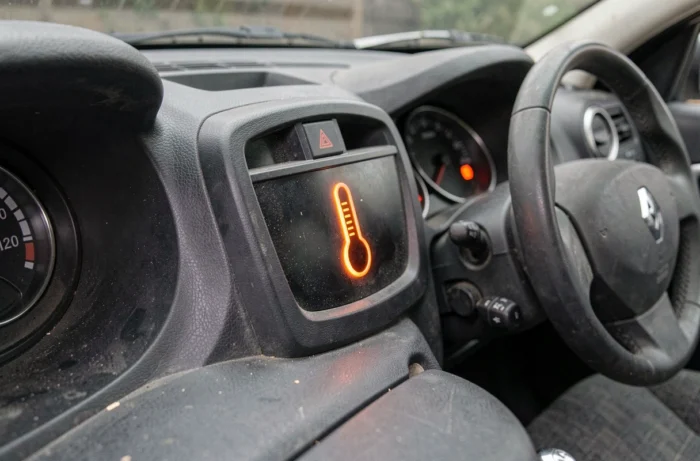
On a a Clio 3, the warning light shaped like a drop above a basin sometimes lights up unexpectedly, often at startup or after a few kilometers. You find yourself staring at the dashboard not knowing if you can continue driving or if you need to turn off the engine immediately. This warning light is directly linked to the coolant level in the expansion tank, and how to address it depends on several factors that we will detail here.
Frequent confusion between warning lights on the Clio 3 dashboard
Before even talking about mechanics, a common issue arises on forums: the drop/basin warning light is confused with other alerts. The Clio 3 displays several orange or yellow pictograms, and some look very similar on an aging or partially lit dashboard.
The brake fluid warning light, for example, can be mistakenly interpreted as the coolant light. To clarify, three elements are important: the color of the light, the exact shape of the pictogram (a drop falling into a rectangular basin for coolant), and the context of its appearance (when stationary, while driving, hot or cold).
An orange light that comes on when stationary and goes off after a few seconds is part of the vehicle’s normal self-test cycle. However, if it stays on or appears while driving, it becomes a real alert signal. To properly understand the meaning of the drop basin light on Clio 3, you must first ensure you are looking at the correct warning.
Faulty level sensor: the trap of false diagnosis
One might think that a lit coolant warning light always means a low level. In practice, an underestimated cause on the Clio 3 is the failure of the level sensor or its float in the expansion tank. The sensor operates with an electrical contact connected to a float. When this float gets stuck in the low position (due to limescale, clogging, wear), the light comes on even if the tank is full.
How to distinguish a true lack of fluid from a faulty sensor
The method is simple but requires a bit of diligence:
- With the engine cold, open the hood and visually check the level in the expansion tank. The fluid should be between the MIN and MAX marks.
- If the level is correct and the light stays on after restarting, disconnect and reconnect the electrical connector of the sensor to check for a poor connection.
- If the light persists despite a normal level and a clean connector, the sensor itself or its wiring is likely at fault.
Replacing a level sensor on Clio 3 remains an accessible operation. The cost of the part is modest, and the intervention does not require draining the entire system. Feedback varies on this point depending on the condition of the wiring, but in most cases, it can be resolved in under an hour.
Light on with low level: check for a leak before topping up
When the level is indeed below the MIN mark, the reflex is to top up with compatible coolant. This may turn off the light, but a top-up that doesn’t hold over time indicates an active leak. You are not solving anything by adding fluid if the system is losing it elsewhere.
Where to look for leaks in the cooling system
On the Clio 3, known weak points of the cooling system are the hoses (especially those near the exhaust manifold), the thermostat gasket, and the expansion tank itself, which can crack over time. A whitish or greenish trace under the vehicle, on the engine side, quickly directs the diagnosis.
If no leak is visible to the naked eye but the level regularly drops, an internal problem should be considered: a failing head gasket can allow fluid to enter the combustion chambers. In this case, white smoke may sometimes be observed from the exhaust or a milky emulsion under the oil cap.
Can you drive with the drop basin light on in Clio 3
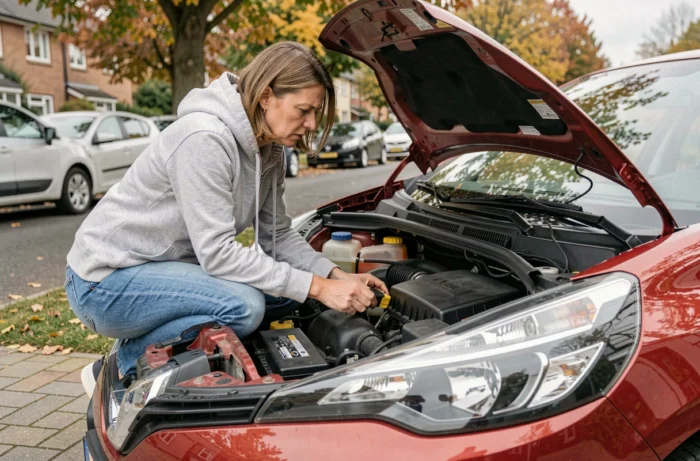
The answer depends on what you observe in parallel. If the engine temperature remains in the normal zone on the dashboard and the light is orange (not red), cautious driving to a safe place to check the level is generally possible in the very short term.
On the other hand, a light accompanied by a rise in temperature requires an immediate stop. Continuing to drive with an overheating engine, even for a few kilometers, can cause warping of the cylinder head or engine seizure. The repair cost then goes from a few euros for a top-up to a bill of several hundred euros for a cylinder head.
Good reflexes in the situation
- Turn off the air conditioning to reduce the thermal load on the engine.
- Turn the heating to maximum: the heating radiator acts as an additional heat dissipator.
- Park as soon as possible, turn off the engine, and wait for it to cool down before opening the expansion tank cap (risk of burns when hot).
- Never add cold water to a still-hot system, as it can cause thermal shock to the engine block.
The drop/basin light on Clio 3 is not a warning to take lightly, but it is also not a death sentence for the engine. In most cases, a methodical check of the level, the condition of the sensor, and the cooling system allows for quick identification of the cause. What costs a lot is not the warning itself, but the time taken to address it.