
A women’s center is a local structure that offers listening, guidance, and support to women facing violence, isolation, or social difficulties. These organizations often operate with physical and telephone availability, sometimes supplemented by digital devices. Knowing how to reach them, and through which channel depending on the situation, saves precious time when every hour counts.
115 as an unknown social relay for women in danger
The most cited numbers for violence against women are 3919 (listening and guidance), 17 (police), and 114 (by SMS for those unable to speak). One channel remains underutilized: the 115, national emergency social number, reachable 7 days a week.
This number triggers departmental regulation capable of directing to appropriate structures: night shelters, emergency accommodation centers for women victims of violence, dedicated services, or, as a last resort, hotel pensions. The social regulation of 115 allows for quick sheltering even when places in traditional accommodations are full, including for women accompanied by children.
To find information on centredefemmesentrelles.org remains a complementary step that allows identifying a local center and its availability hours before traveling.
Availability in women’s centers: access and concrete functioning
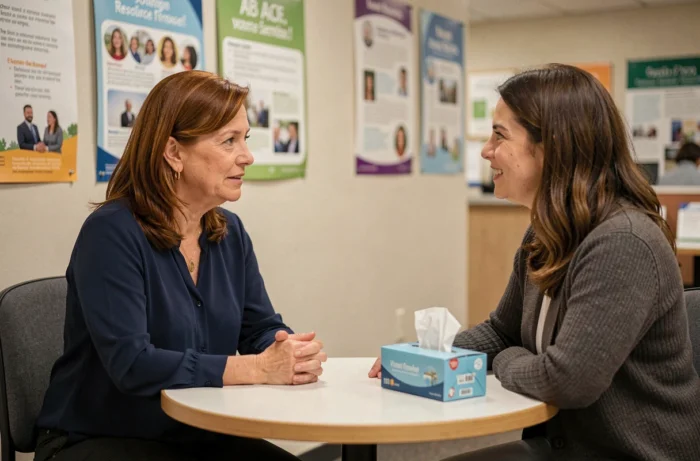
A women’s center is not an emergency service in the medical sense. Most operate on a system of availability with or without appointments, provided by social workers, legal advisors, or psychologists.
Three guidelines to help navigate:
- The CIDFF (Centers for Information on Women’s and Family Rights) offer free consultations in family law, criminal law, and social support. They are present in most departments.
- Specialized associative availability (accommodation, psychological support, assistance with administrative procedures) often operates on fixed time slots, published on the town hall or departmental website.
- The Points of Access to Rights, linked to town halls, direct to the right contact and welcome without appointment during defined time slots.
Before traveling, a phone call to the center’s switchboard allows checking the availability of a time slot and briefly explaining the situation. This step avoids unnecessary travel and speeds up assistance.
Emergency financial aid and New Start Pack: two concrete levers
Leaving a violent home requires immediate resources. Since the end of 2023, the CAF can provide emergency financial aid within a few working days once the complete file is submitted. This system aims to cover initial needs (temporary rent, food, transport) without waiting for the usual delays of social benefits.
The New Start Pack complements this mechanism. It coordinates several administrations to expedite access to housing, employment, and healthcare. Entry into the system generally goes through a social worker, a CIDFF, or a specialized association.
The difference between these two aids lies in their scope. Emergency financial aid addresses an immediate and one-time need. The New Start Pack is part of a support process over several weeks, with individualized follow-up.
Angela system in pharmacies: asking for help without calling
The Angela system is based on a simple principle: enter a partner pharmacy and ask for Angela. The staff then triggers an alert and sheltering procedure. This code also works in certain shops and certified establishments.
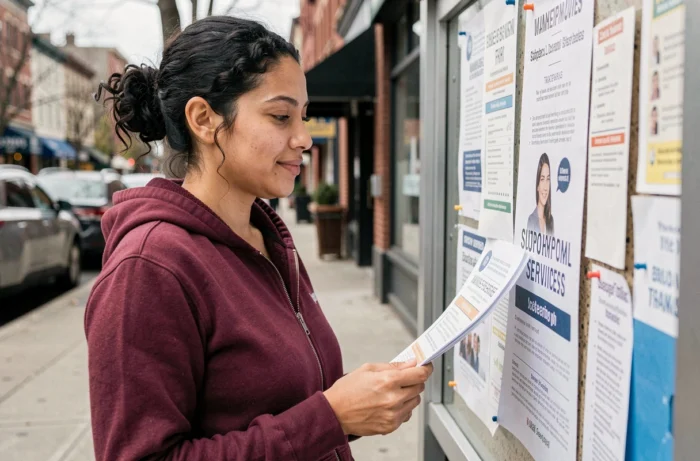
This system offers a decisive advantage for women whose phone is monitored or who cannot make a call. The pharmacy contacts the relevant services (police, local associations) and offers a secure space during the intervention.
The network of participating pharmacies varies by municipality. Town halls and prefecture websites generally publish the list of active Angela points in their area.
Emergency accommodation centers: orientation and available places
When leaving home becomes the only option, the question of accommodation arises within hours. Several structures specifically welcome women victims of violence:
- Emergency accommodation centers (CHU) dedicated to women, accessible via 115 or by referral from an association.
- HEVA-type systems, designed for temporary accommodation with integrated social support.
- Social reintegration accommodation centers (CHRS), which offer a longer stay with a structured exit project.
Calling 115 remains the most direct way to know the available places in real-time. The departmental regulation has an updated view of the accommodation offer and can propose a solution adapted to the family composition.
Social workers from town halls and communal social action centers (CCAS) provide another entry point. They know the local systems and can assist with administrative procedures related to rehousing.
The speed of assistance often depends on the first contact. A call to 3919 for listening and guidance, a call to 115 for sheltering, or a direct visit to a women’s center with open availability: each channel meets a distinct need, and combining them remains the most effective strategy when time is of the essence.