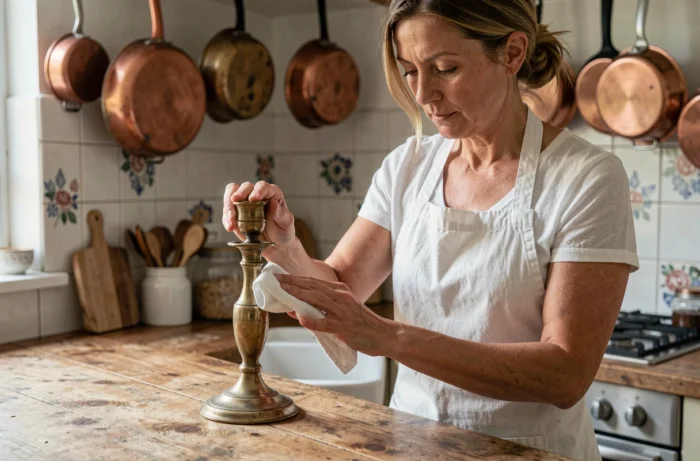
Brass is an alloy of copper and zinc whose surface reacts to oxygen, moisture, and acids present on the skin. This reaction forms a dull, sometimes greenish oxide layer that masks the original golden hue. Restoring shine and luster to brass requires understanding this surface chemistry before choosing a product or method.
Raw brass or lacquered brass: the diagnosis that changes everything about cleaning
Before scrubbing anything, the first step is to determine whether the object is made of raw brass or lacquered brass. The majority of light fixtures, handles, and decorative accessories sold today come from the factory with a thin layer of clear varnish designed to delay oxidation.
On lacquered brass, acidic methods (lemon, vinegar) attack the varnish rather than the oxide. The result: the protective layer degrades in patches, and the brass then tarnishes unevenly, making it much harder to restore than uniform oxidation on raw brass.
To tell the difference, rub a cotton ball soaked in acetone on a discreet area. If the cotton turns yellow or the surface becomes slightly duller, a varnish was present. In this case, a simple wash with warm water and a few drops of soap is sufficient. Reserve acidic recipes for unvarnished raw brass. You will find other decor ideas on Déco en Vogue that detail this distinction in a practical context.
Neutralizing acid after cleaning brass: the step that no one rinses enough
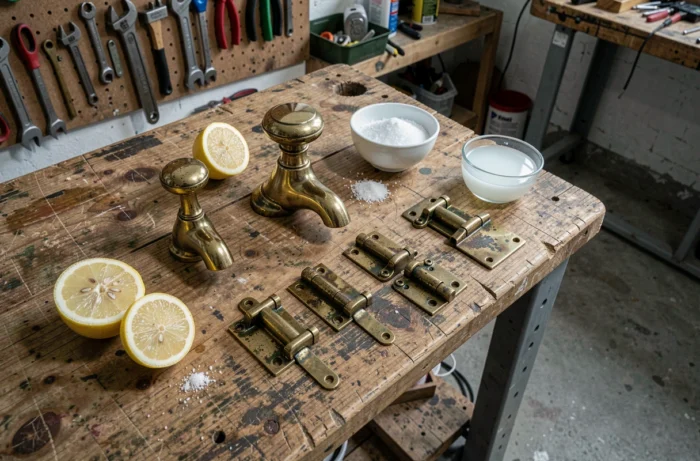
Lemon, white vinegar, and ketchup work due to their acidity, which dissolves the copper oxide layer. The problem arises afterward: an acidic residue left on the surface accelerates reoxidation. Brass becomes dull again faster than before cleaning.
After any acidic method, rinsing with clear water is not always enough. Tap water, slightly hard, can leave white marks on the damp metal. Two actions correct this flaw.
- First, rinse with warm water for about thirty seconds to remove most of the acid, then immediately wipe with a soft, dry cloth.
- On a relief object (chasing, threading), use a second cloth slightly dampened with distilled water to dislodge the acid trapped in the crevices.
- Dry immediately: stagnant water in a groove creates a micro-humid environment that restarts oxidation within hours.
This rinsing protocol makes the difference between a shine that lasts several weeks and visible tarnishing by the next day.
Ammonia and brass under stress: an unknown structural risk
Some guides recommend diluted ammonia to degrease brass. On a trinket placed on a shelf, the risk remains limited if rinsing is thorough. On a functional piece, the situation is different.
Brass is sensitive to a phenomenon called stress corrosion cracking. When a brass piece undergoes mechanical tension (tight threading, stamping, screwing), the presence of ammonia, even at very low concentrations, can initiate micro-cracks that slowly progress through the alloy.
Manufacturers of brass components report that this risk exists with just a few parts per million of residual ammonia on a stressed piece. Specifically, this concerns plumbing fixtures, plumbing connections, screwed light sockets, or pipe ends.
On any screwed or pressurized brass piece, avoid ammonia. Opt for a mixture of baking soda and water, which provides a slightly abrasive action without introducing an aggressive chemical compound for the metal’s structure.
Protecting brass after polishing: wax or oil depending on use
Cleaning brass without protecting it afterward means starting the work over every few weeks. Two protection options exist depending on the type of object.
Microcrystalline wax, used in heritage conservation, leaves an invisible hydrophobic film that slows contact between the alloy and ambient moisture. It is suitable for decorative objects that are not frequently handled: candlesticks, frames, wall sconces. A thin layer applied with a soft cloth, then polished after drying, lasts several months.
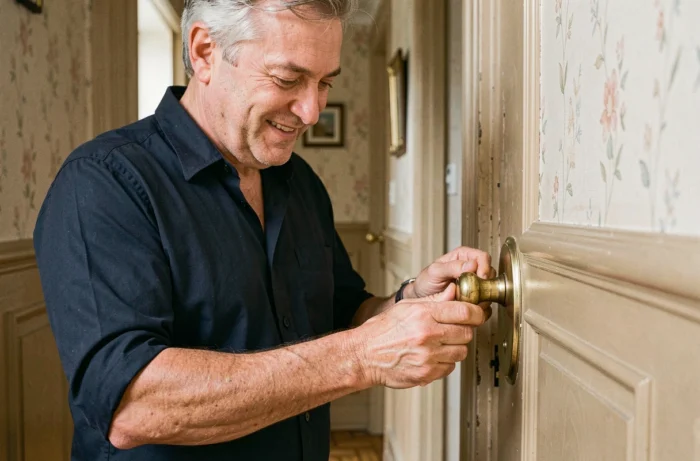
For objects handled daily (door handles, switches, faucets), wax wears off quickly under hand friction. A drop of light mineral oil, wiped with a cloth until no greasy film is perceptible, protects the surface without creating a sticky feeling. The oil does not prevent all oxidation, but it slows it down enough to space out cleanings.
In both cases, apply the protection on perfectly dry and clean brass. Any trace of moisture or acidic residue trapped under the protective layer will continue to oxidize the metal underneath, creating localized stains that are impossible to treat without removing everything.
Regular maintenance of brass: frequency and gestures to adapt
Raw brass exposed to the open air in a humid room (bathroom, kitchen) tarnishes faster than an object placed in a dry living room. Therefore, the cleaning frequency depends as much on the environment as on the level of oxidation tolerated.
For regular maintenance without resorting to acids, a slightly damp microfiber cloth is sufficient to remove dust and fingerprints. This gesture, repeated weekly, delays the accumulation of oxidizing agents on the surface.
When tarnishing appears despite regular maintenance, a paste of baking soda mixed with a few drops of water forms a gentle abrasive that removes oxide without scratching. Apply in circular motions, rinse, dry. Reserve vinegar or lemon for more pronounced oxidation cases, following the rinsing protocol described above.
The tarnishing of brass is not a defect: it is a natural reaction of a living alloy. Some decorators actually seek this patina. Maintenance aims to choose the desired appearance, not to fight against the metal’s chemistry.