Saignac 59 does not appear on any map of France. When you type this name into a search engine, you land on the TV series Commissaire Magellan and its fictional town, not on a municipality in the Nord department. This gap between fiction and real geography deserves attention because it reveals a broader phenomenon: real filming locations benefit from the notoriety of an imaginary city.
Saignac 59 between television fiction and real geography
In Commissaire Magellan, Saignac is presented as a provincial town where the commissioner played by Jacques Spiesser solves his investigations. The “59” found in some searches refers to the Nord department, but the series has never officially placed Saignac in the Hauts-de-France region.
Filming primarily takes place in Île-de-France. Characterful residences like La Mulotterie in Grosrouvre, in the Yvelines, serve as the backdrop for the police station and several recurring scenes. Thus, we are far from the Nord, and those searching for where Saignac 59 is located actually discover a collection of heritage sites scattered throughout the Paris region.
This confusion is common with French series. The fictional city creates a geographical imagination that the viewer associates with a department, a landscape, an accent. But the setting of Saignac is a patchwork of suburban villages, chosen for their architecture and proximity to production studios.
Filming in real locations: how film commissions attract productions
Behind every fictional city in a French series, there is a concrete negotiation between producers and territories. Regional film commissions play a direct role in the choice of filming locations. They offer scouting services, facilitate administrative permits, and sometimes co-finance part of the logistics.
For a municipality, hosting a recurring shoot like that of Commissaire Magellan generates visibility that traditional communication campaigns could not provide. Feedback on this varies depending on the size of the municipality and the duration of exposure, but the trend is documented by regional cinema observatories.
- Scouting agencies list private properties and public buildings as potential sets, with detailed technical sheets (architectural style, accessibility, capacity to accommodate crews)
- Local authorities negotiate benefits: mention of the territory in the credits, hosting local extras, economic benefits in hospitality and catering during filming weeks
- Some municipalities, like Domme in Dordogne, now structure their heritage communication around their role in audiovisual productions, combining cultural tourism and fiction tourism
The shoot becomes a lever for territorial notoriety, not just a one-off event. When a series lasts several seasons, the filming location enters the collective imagination.
Visit the real sets of Commissaire Magellan instead of searching for Saignac
If you want to walk in the footsteps of the commissioner, the most productive approach is to identify the real sites used by the production. Grosrouvre and its surroundings in the Yvelines are the logical starting point.
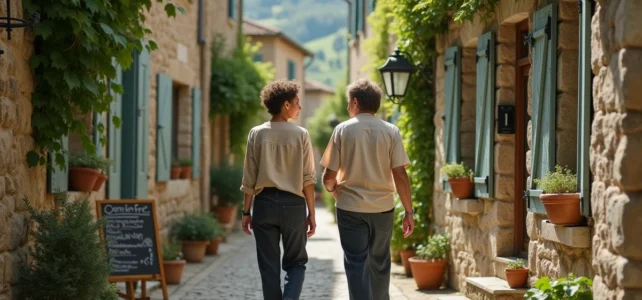
La Mulotterie, a residence listed by agencies specializing in location scouting, is the most emblematic place of the series. The exteriors of the police station and several scenes filmed in the park are recognizable there. The village itself, with its alleys and church, offers an atmosphere that corresponds to what viewers project onto Saignac.
Other sites to spot in Île-de-France
Beyond Grosrouvre, several episodes have been filmed in neighboring municipalities in the Yvelines and Val-d’Oise. The suburban villages of Île-de-France regularly serve as stand-ins for fictional cities in French police series. This technique is found in other productions, making this geographical area a hunting ground for audiovisual tourism enthusiasts.
The challenge remains access: some properties used as sets are private and not freely accessible. Checking access conditions before visiting avoids disappointment.

Fiction tourism in France: a phenomenon that goes beyond Saignac
The case of Saignac 59 illustrates an underlying trend. French series create imaginary geographies that ultimately generate real tourist traffic. Paris has historically concentrated attention with its famous filming locations, but rural and suburban territories are increasingly leveraging this opportunity.
Domme, in Dordogne, is a telling example. A village listed among the most beautiful in France, it combines medieval heritage and presence in audiovisual productions. Its communication strategy blends both dimensions without hierarchy, attracting a broader audience than just fans of old stones.
For municipalities hosting shoots, the challenge is to transform a temporary presence into lasting appeal. This involves on-site signage, marked trails, and sometimes events related to the series (screenings, meetings with technical teams).
- Identify episodes filmed locally and create a related tour
- Collaborate with departmental tourist offices to integrate these routes into regional guides
- Document filming anecdotes, often more attractive than technical sheets of monuments
Saignac does not exist on a map, but the places that give it substance are accessible and worth a visit. Searching for Saignac 59 is actually discovering a network of Île-de-France villages whose architectural heritage captivated casting directors before tourists. The real hidden treasure is these municipalities that live a double life, between their daily routine and their role as a television set.