
We just signed a new lease, the move is scheduled in three weeks, and we realize that the old home insurance policy is still active. Terminating it seems straightforward on paper, but between the legal obligation to remain covered and the setup time for the new policy, the risk of being uninsured or paying two premiums simultaneously is very real.
The trap of coverage gaps between two home insurance policies
When you are a tenant, home insurance is not optional. The landlord can require proof at any time, and the lack of coverage is grounds for terminating the lease. In a shared accommodation, the situation becomes more complicated: a single policy sometimes covers all the roommates, and the departure of one does not automatically release the others from the insurance obligation.
The classic scenario: you terminate the old policy thinking the new one takes effect immediately. In practice, the effective date of the new policy depends on the insurer, and a delay of just a few days can create a legal void. If a claim occurs during this window, neither company will cover the damages.
To avoid this gap, first set the activation date of the new policy before sending the termination request for the old one. By checking the conditions for canceling home insurance, you can precisely identify the applicable notice period and the effective end date of coverage.
In a condominium, an additional level of complexity arises. The insurance for the syndicate covers the common areas, but each co-owner must insure their private parts. Terminating without verifying what the syndicate’s policy actually covers risks discovering too late that certain damages (such as private water damage) are no longer covered by anyone.

Termination after one year of contract: what the Hamon law changes concretely
Since the Hamon law, you can terminate at any time after the first year, without fees or reason. This is the most commonly used mechanism, and also the one that generates the most confusion regarding deadlines.
The process is straightforward: you send a termination request (registered letter, or increasingly often electronically). The termination takes effect one month after the insurer receives the request. This one-month notice is non-negotiable.
- The contract must be more than one year old at the date of sending the request, not at the desired effective date
- The insurer is required to refund any overpaid premium on a pro-rata basis, within thirty days after the effective termination
- If you delegate the termination to the new insurer (contract transfer), they handle the registered letter, but the one-month notice still applies
A common pitfall concerns contracts taken out remotely. A fourteen-day withdrawal period may apply if the contract was concluded online or by phone. This right of withdrawal exists alongside the right of termination and allows canceling a recent contract without waiting a year.
Termination due to moving: deadlines to respect to avoid double payment
Moving remains the most common reason for early termination (before one year). You inform the insurer of the change of address, and the contract can be terminated within the deadlines set by the insurance code.
In practice, you must notify the move by registered letter, attaching proof (new lease, deed of sale, proof of residence). The termination takes effect one month after notification, unless the insurer offers to maintain the contract for the new home under adapted conditions.
Responses vary on this point: some insurers accept a simple email with an attachment, while others require a paper registered letter. Checking the general conditions of the contract before sending anything avoids back-and-forth.
Particular case of shared accommodation with the departure of a roommate
When a roommate leaves the accommodation without the others moving, the contract does not automatically stop. If the contract is in the name of the departing roommate, the remaining roommates must take out a new contract immediately. If the contract is collective, an amendment is generally sufficient to remove the name of the departing roommate, but each remaining roommate must verify that they are still covered.
When the insurer terminates your home contract: what happens next
Termination does not only go one way. The insurer can end the contract in case of non-payment of the premium, unreported aggravation of risk, or false declaration. The practical consequences are more severe than a voluntary termination.
- After a termination for non-payment, the insured’s profile is recorded in files consulted by other insurers, complicating the subscription of a new contract
- In case of false declaration, the insurer can refuse any compensation for previous claims, in addition to terminating the contract
- The tenant’s insurance obligation continues: you must find an insurer quickly, even if the rates offered will be higher for a terminated profile
For a non-occupying owner renting out their property, termination by the insurer of a non-occupying owner policy (PNO) requires finding replacement coverage before the next condominium meeting, or risk no longer being in compliance with the regulations.
Home insurance termination letter: what must be included
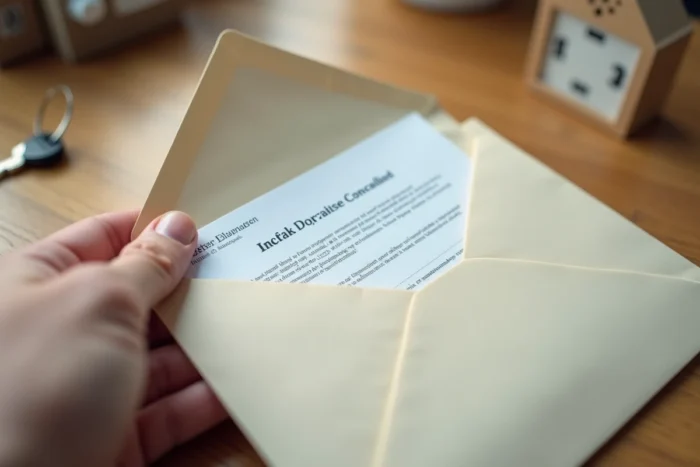
The registered letter remains the safest channel to formalize the termination. Its content must include the contract references (policy number), the desired effective date, and the reason invoked if the termination occurs before one year (moving, change of situation).
A registered letter with acknowledgment of receipt secures proof of the date of sending, which is crucial for calculating the notice period. Some insurers now offer termination via an online client space, but the contract itself specifies the accepted modalities.
For a termination under the Hamon law after one year, no reason is required. The letter can be limited to a formal request accompanied by the contract references. There is no need to write three paragraphs of explanation: one sentence is sufficient if the identification information is complete.
Whether you are a departing tenant, a transitioning roommate, or a co-owner changing insurers, terminating a home insurance policy relies on a precise sequence: verify the applicable notice period, confirm the activation date of the new contract, and only then send the request. Reversing the order exposes you to a coverage gap that neither the landlord nor the syndicate will tolerate for long.